Quotessence
Home / Quotes / Quote by Simone Weil

Quote by Simone Weil

“At the very best, a mind enclosed in language is in prison. It is limited to the number of relations which words can make simultaneously present to it; and remains in ignorance of thoughts which involve the combination of a greater number. These thoughts are outside language, they are unformulable, although they are perfectly rigorous and clear and although every one of the relations they involve is capable of precise expression in words. So the mind moves in a closed space of partial truth, which may be larger or smaller, without ever being able so much as to glance at what is outside.”

Quote by Simone Weil

Author
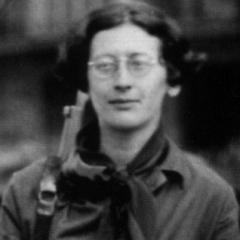
Simone Weil
Simone Weil

Simone Weil was a French philosopher, social activist, and writer. Born on February 3, 1909, and died on August 24, 1943, Weil is known for her profound philosophical thinking and her passionate commitment to social justice. Her works have had a significant impact on later philosophers and social thinkers. more

You May Also Like

“What would you do if you could snap your fingers and make it all different?" Melody didn't even hesitate. "Open my own place. French-inspired, most likely, with all those amazing pastries I fell in love with in Paris. Maybe light lunch fare. Hearty bread, the way it's supposed to be done- heirloom wheat baguettes baked bien cuit, that point just before burnt where the crust gets rich and caramelly.”

“Our idea was to provide a platform for aspiring poets who can go on to say that they have been published alongside so and so. Often first-time writers are told that they need to experience life and write more. Putting the works side-by-side was to give young talent an edge. For instance, an 18-year-old’s works went alongside Gulzar’s, she (Fouqia) points out. - The New Indian Express”

“For activists ready to become arbiters of justice, or for seekers ready to learn new spells, Horse Magick can provide a problem-solving grimoire that draws on the ultimate symbol of freedom, passion, and power - the horse.”

“But he was not beyond it, he knew, and would never be. Beneath the numbness, the indifference, the removal, it was there, intense and steady; it had always been there. In his youth he had given it freely, without thought; he had given it to the knowledge that had been revealed to him--how many years ago?--by Archer Sloane; he had given it to Edith, in those first blind foolish days of his courtship and marriage; and he had given it to Katherine, as if it had never been given before. He had, in odd ways, given it to every moment of his life, and had perhaps given it most fully when he was unaware of his giving. It was a passion neither of the mind nor of the flesh; rather, it was a force that comprehended them both, as if they were but the matter of love, its specific substance. To a woman or to a poem, it said simply: Look! I am alive.”