Quotessence
Home / Quotes / Quote by Neil deGrasse Tyson

Quote by Neil deGrasse Tyson

“Here's what I'm wondering: if, digitally, you can remove red-eye, smooth over wrinkles, make people look thinner, then why don't we have the technology to make me sing better?”

Quote by Neil deGrasse Tyson

Author
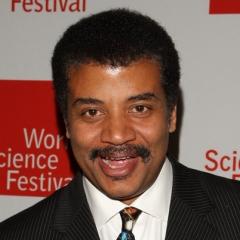
Neil deGrasse Tyson
Neil deGrasse Tyson

Neil deGrasse Tyson is an American astrophysicist, science communicator, and television personality. Born on October 5, 1958, he is renowned for his deep understanding of the cosmos and his ability to popularize scientific knowledge. Tyson grew up in New York City and earned a Ph.D. in astronomy from Columbia University. He served as the director of the Hayden Planetarium at the American Museum of Natural History and has been a member of various scientific committees. more

You May Also Like

“Corporate organization in American business and commerce was already well under way by the time Abraham Lincoln became president. But all the evidence from his pre-war lawyering days is that he had little objection to the rise of corporations. As a state legislator, he had strongly favored the creation of an Illinois state bank, as well as sponsoring the chartering of public/private corporations like the Illinois Central Railroad.”

“Remember that Abraham Lincoln was a Whig far longer than he was a Republican. As a whole, the Whigs looked upon banks and corporations as a more efficient means of development; the Jacksonian Democrats thought they were the tools of the devil, but Whigs like Lincoln disagreed. During his presidency, Lincoln favored the re-construction of a national financial system, and his most important 'internal improvement' project was the Pacific railroad.”

“Modern presidential debating only started with Richard Nixon and John F.Kennedy in 1960, although the proximity of that to the Lincoln-Douglas centennial is more than accidental. The reason is, I think, the medium. Abraham Lincoln and Stephen A. Douglas were talking, but the talking was in terms of logic, development, and reasoning. Television, as a medium, resists those qualities in speaking - it favors quick cuts, one-liners, and talking points. I think the modern debates are largely the prisoners of the televised medium”

“I suspect, too, that the modern debates represent the effort of candidates with widely-varying constituencies and special interests to please to tip the hat as quickly as possible to as many of the constituencies and interests as possible. That leaves no time for big-picture issues. Contrast this with Abraham Lincoln and Stephen A. Douglas, where the subject was only ever slavery, and the discussion went right to the bedrock of what a democracy is all about.”

“I don't know that there has ever been a time when Abraham Lincoln didn't stand head-and-shoulders above all other presidents in the historians' eye. But relatively speaking, there have been peaks and a troughs. One peak was in the 1910s-20s; a major trough was in the 1970s-80s. We are certainly on a peak again, something which began in 1994 with Michael Burlingame's 'The Inner World of Abraham Lincoln,' which showed in fabulous detail how many new and untapped sources were available on Lincoln.”