Quotessence
Home / Quotes / Quote by Donald Cram

Quote by Donald Cram

“Few scientists acquainted with the chemistry of biological systems at the molecular level can avoid being inspired. Evolution has produced chemical compounds exquisitely organized to accomplish the most complicated and delicate of tasks. Many organic chemists viewing crystal structures of enzyme systems or nucleic acids and knowing the marvels of specificity of the immune systems must dream of designing and synthesizing simpler organic compounds that imitate working features of these naturally occurring compounds.”

Quote by Donald Cram

Author
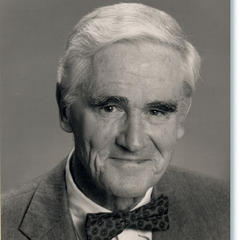
Donald Cram
Donald Cram

Donald Cram was a renowned chemist known for his significant contributions to organic chemistry. He was born on April 22, 1919, in Chicago, Illinois, USA, and throughout his academic career, he achieved numerous important milestones. Cram's research focused on the synthesis of cyclic compounds and the theory of stereochemistry, which laid a solid foundation for the development of organic chemistry. In 1987, he was awarded the Nobel Prize in Chemistry for his work in these areas. more

You May Also Like

“Five per cent vision is better than no vision at all. Five per cent hearing is better than no hearing at all. Five per cent flight efficiency is better than no flight at all. It is thoroughly believable that every organ or apparatus that we actually see is the product of a smooth trajectory through animal space, a trajectory in which every intermediate stage assisted survival and reproduction.”

“For my own part I would as soon be descended from that heroic little monkey, who braved his dreaded enemy in order to save the life of his keeper; or from that old baboon, who, descending from the mountains, carried away in triumph his young comrade from a crowd of astonished dogs-as from a savage who delights to torture his enemies, offers up bloody sacrifices, practices infanticide without remorse, treats his wives like slaves, knows no decency, and is haunted by the grossest superstitions.”

“For three million years we were hunter-gatherers, and it was through the evolutionary pressures of that way of life that a brain so adaptable and so creative eventually emerged. Today we stand with the brains of hunter-gatherers in our heads, looking out on a modern world made comfortable for some by the fruits of human inventiveness, and made miserable for others by the scandal of deprivation in the midst of plenty.”

“Genius and science have burst the limits of space, and few observations, explained by just reasoning, have unveiled the mechanism of the universe. Would it not also be glorious for man to burst the limits of time, and, by a few observations, to ascertain the history of this world, and the series of events which preceded the birth of the human race?”