Quotessence
Home / Quotes / Quote by Aristotle

Quote by Aristotle

“For man, when perfected, is the best of animals, but, when separated from law and justice, he is the worst of all; since armed injustice is the more dangerous, and he is equipped at birth with the arms of intelligence and with moral qualities which he may use for the worst ends. Wherefore, if he have not virtue, he is the most unholy and the most savage of animals, and the most full of lust and gluttony. But justice is the bond of men in states, and the administration of justice, which is the determination of what is just, is the principle of order in political society.”

Quote by Aristotle

Work

Aristotle

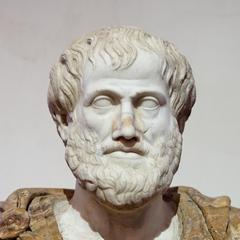
Aristotle, born in 384 BC, was a Greek philosopher who taught at the Lyceum. His works cover a wide range of subjects, including metaphysics, biology, physics, and aesthetics. His most famous works include 'Nicomachean Ethics,' which explores virtue and happiness, and 'Poetics,' which discusses the nature of tragedy. Aristotle's systematic approach to knowledge and his emphasis on empirical observation have made him a pivotal figure in the history of philosophy. more

Author

Aristotle
Aristotle

Aristotle, a renowned Greek philosopher, is one of the founders of Western philosophy. His thoughts covered a wide range of fields, including ethics, logic, politics, and had a profound impact on the world. more

You May Also Like

“I knelt and prayed, and the strongest truth came over me. Didn't matter if God in his heaven was a Catholic or a Protestant God, or the God of the Hindus. What mattered was something deeper and older and more powerful than any such image - it was a concept of goodness based upon the affirmation of life, the turning away from destruction, from the perverse, from man using and abusing man. It was the affirmation of the human and the natural.”

“And sometimes then he sat with us for an hour or so, sharing our limbo, listening while I read. Books from any shelf, opened at any page, in which I would start and finish anywhere, mid-sentence sometimes. Wuthering Heights ran into Emma, which gave way to The Eustace Diamonds, which faded into Hard Times, which ceded to The Woman in White. Fragments. It didn't matter. Art, its completeness, its formedness, its finishedness, had no power to console. Words, on the other hand, were a lifeline.”

“The kiss was innocent--innocent enough--but it was also full of something not unlike what Virginia wants from London, from life; it was full of a love complex and ravenous, ancient, neither this nor that. It will serve as this afternoon's manifestation of the central mystery itself, the elusive brightness that shines from the edges of certain dreams; the brightness which, when we awaken, is already fading from our minds, and which we rise in the hope of finding, perhaps today, this new day in which anything might happen, anything at all.”

“In the first place, you shouldn't believe in promises. The world is full of them: the promises of riches, of eternal salvation, of infinite love. Some people think they can promise anything, others accept whatever seems to guarantee better days ahead, as, I suspect is your case. Those who make promises they don't keep end up powerless and frustrated, and exactly the fate awaits those who believe promises.”