Quotessence
Home / Quotes / Quote by John Dewey

Quote by John Dewey

Work

The Middle Works of John Dewey, 1899-1924, Volume 5: Ethics: 1908

The Middle Works of John Dewey, Volume 5, is a compilation of Dewey's philosophical essays and lectures on ethics. It includes his reflections on moral philosophy, social ethics, and the role of ethics in education and society. This volume is significant for its exploration of Dewey's pragmatic approach to ethics and its influence on contemporary ethical thought. more

Author
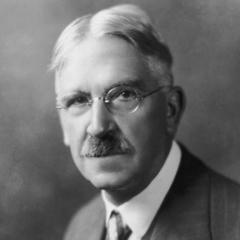
John Dewey
John Dewey

John Dewey was an American philosopher and educator, born on October 20, 1859, and died on June 1, 1952. He was a leading figure in the philosophy of pragmatism and had a profound impact on 20th-century education, philosophy, and the social sciences. more

You May Also Like

“It was not until some weeks later that I realized there is no need to restrict oneself to 2 by 2 matrices. One could go on to 4 by 4 matrices, and the problem is then easily soluable. In retrospect, it seems strange that one can be so much held up over such an elementary point. The resulting wave equation for the electron turned out to be very successful. It led to correct values for the spin and the magnetic moment. This was quite unexpected. The work all followed from a study of pretty mathematics, without any thought being given to these physical properties of the electron.”

“In the "commentatio" (note presented to the Russian Academy) in which his theorem on polyhedra (on the number of faces, edges and vertices) was first published Euler gives no proof. In place of a proof, he offers an inductive argument: he verifies the relation in a variety of special cases. There is little doubt that he also discovered the theorem, as many of his other results, inductively.”

“Arithmetic starts with the integers and proceeds by successively enlarging the number system by rational and negative numbers, irrational numbers, etc... But the next quite logical step after the reals, namely the introduction of infinitesimals, has simply been omitted. I think, in coming centuries it will be considered a great oddity in the history of mathematics that the first exact theory of infinitesimals was developed 300 years after the invention of the differential calculus.”

“Let's face it: Serious self-scrutiny has not been one of our notable characteristics. We are far more aware of what we want to change in others than we are of how we need to change. Salvation for our educational ills is only secondarily "out there." Primarily it will have to come from within an educational community willing to say that we have met the enemy and it is us.”

“The question for the ultimate foundations and the ultimate meaning of mathematics remains open; we do not know in which direction it will find its final solution nor even whether a final objective answer can be expected at all. "Mathematizing" may well be a creative activity of man, like language or music, of primary originality, whose historical decisions defy complete objective rationalization.”