Quotessence
Home / Quotes / Quote by Gregory of Nazianzus

Quote by Gregory of Nazianzus

“If our Lord ascends up to Heaven, ascend with Him. Be one of those angels who escort Him, or one of those who receive Him. Bid the gates be lifted up (cf. Ps. 24:7, 10), or be made higher, that they may receive Him, exalted after His Passion. Answer to those who are in doubt because He bears up with Him His body and the tokens of His Passion, which He had not when He came down, and who therefore inquire, 'Who is this King of Glory?' that it is the Lord strong and mighty, as in all things that He has done from time to time and does, so now in His battle and triumph for the sake of Mankind.”

Quote by Gregory of Nazianzus

Author
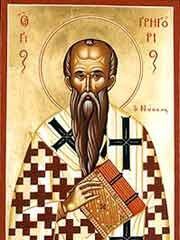
Gregory of Nazianzus

Gregory of Nazianzus (330-390 AD) was an influential Christian saint, theologian, and poet. He is renowned for his contributions to the doctrine of the Trinity within Christian theology. Born in Nazianzus, Asia Minor, he was the brother of Basil of Caesarea, another prominent theologian. His writings and sermons are still widely referenced in the Christian church today. more

You May Also Like

“Being come together in the same place, let there be one prayer, one supplication, one mind, one hope, in love and in joy undefiled. There is one Jesus Christ, than Whom nothing is more excellent. Therefore all should run together as into one temple of God, as to one altar, as to one Jesus Christ, who came forth from the Father, and is with and has gone to one.”

“True spiritual knowledge has sometimes flourished most grandly in some who were without eloquence and almost illiterate. And this is very clearly shown by the case of the Apostles and many holy men, who did not spread themselves out with an empty show of leaves, but were bowed down by the weight of the true fruits of spiritual knowledge: of whom it is written in Acts: 'But when they saw the boldness of Peter and John, and perceived that they were ignorant and unlearned men, they were astonished' (Acts 4:13).”

“It is not enough to know the Son of God in the Father's nature only, unless we acknowledge Him in what is ours without withdrawal of what is His own. For that self-emptying, which He underwent for man's restoration, was the dispensation of compassion, not the loss of power. For, though by the eternal purpose of God there was 'no other name under heaven given to men whereby they must be saved' (Acts 4:12), the Invisible made His substance visible, the Intemporal temporal, the Impassable passable: not that power might sink into weakness, but that weakness might pass into indestructible power.”