Quotessence
Home / Quotes / Quote by Ayn Rand

Quote by Ayn Rand

“Man has no automatic code of survival. His particular distinction from all other living species is the necessity to act in the face of alternatives by means of volitional choice. He has no automatic knowledge of what is good for him or evil, what values his life depends on, what course of action it requires. Are you prattling about an instinct of self-preservation? An instinct of self-preservation is precisely what man does not possess. An 'instinct' in as unerring and automatic form of knowledge. A desire is not an instinct. A desire to live does not give you the knowledge required for living. And even man's desire to live is not automatic: your secret evil today is that that is the desire you do not hold. Your fear of death is not a love of life and will not give you the knowledge needed to keep it. Man must obtain his knowledge and choose his actions by a process of thinking, which nature will not force him to perform. Man has the power to act as his own destroyer--and that is the way he has acted through most of history.”

Quote by Ayn Rand

Work

Atlas Shrugged

Atlas Shrugged is a novel that delves into themes of individualism, objectivism, and economic theory. It follows a diverse cast of characters as they navigate a dystopian future where the productive members of society withdraw their efforts in protest against the oppressive government. more

Author
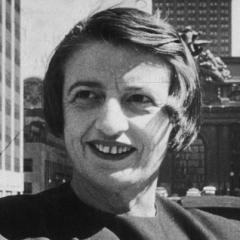
Ayn Rand
Ayn Rand

American novelist and philosopher, known for her novels and philosophical ideas. Her works emphasize individualism, free markets, and rationalism, and have had a profound impact on politics and philosophy in the late 20th century. more

You May Also Like

“Were we to confront our creaturehood squarely, how would we propose to educate? The answer, I think is implied in the root of the word education, educe, which means "to draw out." What needs to be drawn out is our affinity for life. That affinity needs opportunities to grow and flourish, it needs to be validated, it needs to be instructed and disciplined, and it needs to be harnessed to the goal of building humane and sustainable societies. Education that builds on our affinity for life would lead to a kind of awakening of possibilities and potentials that lie dormant and unused in the industrial-utilitarian mind. Therefore the task of education, as Dave Forman stated, is to help us 'open our souls to love this glorious, luxuriant, animated, planet.' The good news is that our own nature will help us in the process if we let it.”

“When we see that almost everything men devote their lives to attain, sparing no effort and encountering a thousand toils and dangers in the process, has, in the end, no further object than to raise themselves in the estimation of others; when we see that not only offices, titles, decorations, but also wealth, nay, even knowledge[1] and art, are striven for only to obtain, as the ultimate goal of all effort, greater respect from one's fellowmen,—is not this a lamentable proof of the extent to which human folly can go?”

“Jesus wept. He knew sorrow. Jesus felt pain. He knew suffering. Jesus felt hunger. He knew malnourishment. Jesus felt exhausted. He knew weariness. Jesus was rejected. He knew loneliness. Jesus was betrayed. He knew heartbreak. Jesus was tempted. He knew the battle within. And yet… He overcame it all. This is the Jesus who sees you… who understands you. God sees you. God hears you. God will carry you through.”

“You know, there's a place we all inhabit, but we don't much think about it, we're scarcely conscious of it, and it lasts for less than a minute a day. It's in the morning, for most of us. It's that time, those few seconds when we're coming out of sleep but we're not really awake yet. For those few seconds we're something more primitive than what we are about to become. We have just slept the sleep of our most distant ancestors, and something of them and their world still clings to us. For those few moments we are unformed, uncivilized. We are not the people we know as ourselves, but creatures more in tune with a tree than a keyboard. We are untitled, unnamed, natural, suspended between was and will be, the tadpole before the frog, the worm before the butterfly. We are, for a few brief moments, anything and everything we could be.”

“To be human is to be 'a' human, a specific person with a life history and idiosyncrasy and point of view; artificial intelligence suggest that the line between intelligent machines and people blurs most when a puree is made of that identity.”