Quotessence
Home / Quotes / Quote by Immanuel Kant

Quote by Immanuel Kant

“The people naturally adhere most to doctrines which demand the least self-exertion and the least use of their own reason, and which can best accommodate their duties to their inclinations.”

Quote by Immanuel Kant

Author
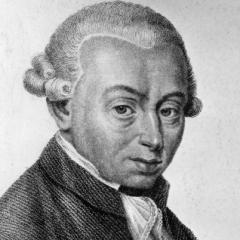
Immanuel Kant
Immanuel Kant

German philosopher, an important representative of the Enlightenment movement, and the founder of the Kantian philosophical system. His thoughts have had a profound impact on the fields of philosophy, ethics, political science, and others. more

You May Also Like

“You know, there's a place we all inhabit, but we don't much think about it, we're scarcely conscious of it, and it lasts for less than a minute a day. It's in the morning, for most of us. It's that time, those few seconds when we're coming out of sleep but we're not really awake yet. For those few seconds we're something more primitive than what we are about to become. We have just slept the sleep of our most distant ancestors, and something of them and their world still clings to us. For those few moments we are unformed, uncivilized. We are not the people we know as ourselves, but creatures more in tune with a tree than a keyboard. We are untitled, unnamed, natural, suspended between was and will be, the tadpole before the frog, the worm before the butterfly. We are, for a few brief moments, anything and everything we could be.”

“To be human is to be 'a' human, a specific person with a life history and idiosyncrasy and point of view; artificial intelligence suggest that the line between intelligent machines and people blurs most when a puree is made of that identity.”

“But what about human nature? Can it be changed? And if not, will it endure under Anarchism? Poor human nature, what horrible crimes have been committed in thy name! Every fool, from king to policeman, from the flatheaded parson to the visionless dabbler in science, presumes to speak authoritatively of human nature. The greater the mental charlatan, the more definite his insistence on the wickedness and weaknesses of human nature. Yet, how can any one speak of it today, with every soul in a prison, with every heart fettered, wounded, and maimed? John Burroughs has stated that experimental study of animals in captivity is absolutely useless. Their character, their habits, their appetites undergo a complete transformation when torn from their soil in field and forest. With human nature caged in a narrow space, whipped daily into submission, how can we speak of its potentialities? Freedom, expansion, opportunity, and, above all, peace and repose, alone can teach us the real dominant factors of human nature and all its wonderful possibilities. Anarchism, then, really stands for the liberation of the human mind from the dominion of religion; the liberation of the human body from the dominion of property; liberation from the shackles and restraint of government. Anarchism stands for a social order based on the free grouping of individuals for the purpose of producing real social wealth; an order that will guarantee to every human being free access to the earth and full enjoyment of the necessities of life, according to individual desires, tastes, and inclinations. This is not a wild fancy or an aberration of the mind. It is the conclusion arrived at by hosts of intellectual men and women the world over; a conclusion resulting from the close and studious observation of the tendencies of modern society: individual liberty and economic equality, the twin forces for the birth of what is fine and true in man.”