Quotessence
Home / Quotes / Quote by Leo Tolstoy

Quote by Leo Tolstoy

“But to us of a later generation...it is inconceivable that millions of Christian men should have killed and tortured each other, because Napoleon was ambitious, Alexander firm, English policy crafty, and the Duke of Oldenburg hardly treated. We cannot grasp the connections between these circumstances and the bare fact of murder and violence, nor why the duke's wrongs should induce thousands of men from the other side of Europe to pillage and murder the inhabitants of the Smolensk and Moscow provinces and to be slaughtered by them.”

Quote by Leo Tolstoy

Work

War and Peace

A profound and sweeping narrative that delves into the complexities of human relationships and the impact of historical events on individuals, "War and Peace" is renowned for its rich character development and intricate portrayal of the Napoleonic era. more

Author

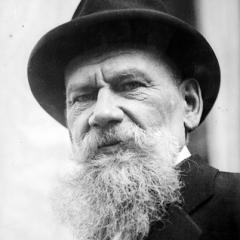
Leo Tolstoy
Leo Tolstoy

Leo Tolstoy was a Russian writer and thinker, a prominent representative of 19th-century Russian literature. His works deeply revealed social contradictions and human nature, and had a profound impact on the world. more

You May Also Like

“But all these hints at foreseeing what actually did happen on the French as well as on the Russian side are only conspicuous now because the event has justified them. If the event had not come to pass, these hints would have been forgotten, as thousands and millions of suggestions and supposition are now forgotten that were current at the period, but have been shown by time to be unfounded and so have been consigned to oblivion.”

“Some had hurled spears first. Those spears thumped into our shields, making them unwieldy, but it hardly mattered. The leading Danes tripped on the hidden timbers and the men behind pushed the falling men forward. I kicked one in the face, feeling my iron-reinforced boot crush bone. Danes were sprawling at our feet while others tried to get past their fallen comrades to reach our line, and we were killing. Two men succeeded in reaching us, despite the smoking barricade, and one of those two feel to Wasp-Sting coming up from beneath his shield-rim. He had been swinging an ax that the man behind me caught on his shield and the Dane was still holding the war ax's shaft as I saw his eyes widen, saw the snarl of his mouth turn to agony as I saw his eyes widen, saw the snarl of his mouth turn to agony as I twisted the blade, ripping it upward, and as Cerdic, beside me, chopped his own ax down. The man with the crushed face was holding my ankle and I stabbed at him as the blood spray from Cerdic's ax blinded me. The whimpering man at my feet tried to crawl away, but Finan stabbed his sword into his thigh, then stabbed again. A Dane had hooked up his ax over the top rim of my shield and hauled it down to expose my body to a spear-thrust, but the ax rolled off the circular shield and the spear was deflected upward and I slammed Wasp-Sting forward again, felt her bite, twisted her, and Finan was keening his mad Irish song as he added his own blade to the slaughter. “Keep the shields touching!” I shouted at my men.”

“He who kills from afar knows nothing at all about act of killing. He who kills from afar derives no lesson from life or from death; he neither risks nor stains his hands with blood, nor hears the breathing of his adversary, nor reads the fear, courage, or indifference in his eyes. He who kills from afar tests neither his arm, his heart, nor his conscience, nor does he create ghosts that will later haunt him every single night for the rest of his life. He who kills from afar is a knave who commends to others the dirty and terrible task that is his own.”

“I wonder where he lies. Wedged under a rock, with a thousand small mouths already sucking on his spongy flesh. Or floating still, on and down, on and down, to wider, calmer reaches of the river. I see them gathering: the drowned, the shot. Their hands float out to touch each other, fingertip to fingertip. In a day, two days, they will glide on, a funeral flotilla, past the unfinished white dome rising out of its scaffolds on a muddy hill in Washington. Will the citizens recognize them, the brave fallen, and uncover in a gesture of respect? Or will they turn away, disgusted by the bloated mass of human rot?”

Book:March

“In the midst of the heavy, hot fragrance of summer, and of the clean salty smell of the sea, there was the odor of wounded men, a sickly odor of blood and antiseptics which marked the zone of every military hospital. All Athens quickly took on that odor, as the wounded Greek soldiers were moved out of hospitals and piled into empty warehouses to make way for German wounded. Now every church, every empty lot, every school building in Athens is full of wounded, and on the pathways of Zappion, the park in the heart of Athens, bandaged men in makeshift wheel chairs are to be seen wherever one walks. Zappion is a profusion of flowers, heavy-scented luxurious flowers; but even the flower fragrance is not as strong as that of blood.”