Quotessence
Home / Quotes / Quote by Ernest Hemingway

Quote by Ernest Hemingway

“So far, about morals, I know only that what is moral is what you feel good after and what is immoral is what you feel bad after and judged by these moral standards, which I do not defend, the bullfight is very moral to me because I feel very fine while it is going on and have a feeling of life and death and mortality and immortality, and after it is over I feel very sad but very fine.”

Quote by Ernest Hemingway

Work

Death in the Afternoon

An in-depth analysis of the sport of bullfighting, its history, and its role in Spanish culture, written by the author of 'The Sun Also Rises'. more

Author
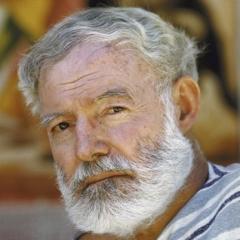
Ernest Hemingway
Ernest Hemingway

American author known for his concise and forceful writing style, as well as his profound insights into life. Hemingway's works cover a wide range of themes including war, adventure, and love, with notable titles such as 'The Old Man and the Sea' and 'A Farewell to Arms'. more

You May Also Like

“I’ve always hated it when authors seem to find joy In killing my favorite characters. With gleaming eyes they toy With turmoil in every chapter. Just when they’ve got you attached To the character’s quirks and flaws To their words and their demons Just when you’ve fallen in love With the character’s identity— With a cruel turn of the lip The author smirks and kills them off And at our gasped pleas, merely scoffs. But the author was God And my favorite character was you And I still can’t believe You’re gone.”

“Inescapable shock research continues to the present day. Although I am not a PETA person, I think it bears mentioning (again) that other species do not deliberately inflict uncontrollable, inescapable pain. Only humans do this — in the psych lab, in abusive families, in prisons, and in the extreme sadism of sexual psychopaths. Deliberate cruelty and the instrumental use of others is the sole province of homo sapiens.”

“I will inflict upon the innocent Harry my new firmness and power. His worship adds to this new power. Here I am the conqueror, not the sufferer. It is not a story of love, it is a story of power. Poor Harry. I should deliver him of myself, for he has a dream of love. I have made all other women distasteful to him, and he is entirely at my mercy. Every gesture I make affects his body and soul. It is an unequal encounter. Yet he feels he is being given heaven itself, the answer to all his hungers. The hunger of the poor Jewish boy born in ugliness and deprivation.”

“My body was quiet after the orgy. I felt power; I felt I was taking revenge. I was inflicting pain, being unfaithful, desecrating all the delicacies in Bill and in myself. Wilson, who has big needs, needed me, wanted all I could give, wanted me for a wife, a collaborator, a mistress, one to enjoy power with, his two houses, his position of power, his last ten years of achievement, but I starve him, elude him. He telephones. I inflict the suffering on him that was inflicted on me by another, but only because I do not love. So it must mean that those who behaved as I do now do not love.”