Quotessence
Home / Quotes / Quote by Joan Didion

Quote by Joan Didion

“their suburbia house in Brentwood" was how she referred to the house when we bought it, a twelve-year-old establishing that it was not her decision, not her taste, a child claiming the distance all children imagine themselves to need.”

Quote by Joan Didion

Work

Blue Nights

In 'Blue Nights,' the author examines the vulnerabilities of later life and the painful process of losing a child. The narrative weaves together personal reflections on her own aging with memories of her daughter, exploring themes of time, memory, and the inevitable sorrows that accompany deep love. The title refers to the extended twilight hours of summer, which serve as a metaphor for the period of life marked by heightened awareness of mortality and the preciousness of fleeting moments. more
Author

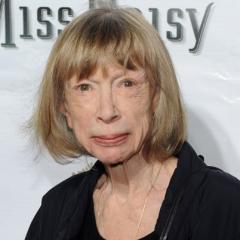
Joan Didion
Joan Didion

Joan Didion is an American author born on December 5, 1934. Known for her distinctive narrative style and profound insights into modern life, her works have gained recognition for their unique perspective and deep understanding of the complexities of contemporary society. more

You May Also Like

“Most people are afflicted with an inability to say what they see or think. They say there’s nothing more difficult than to define a spiral in words; they claim it is necessary to use the unliterary hand, twirling it in a steadily upward direction, so that human eyes will perceive the abstract figure immanent in wire spring and a certain type of staircase. But if we remember that to say is to renew, we will have no trouble defining a spiral; it’s a circle that rises without ever closing. I realize that most people would never dare to define it this way, for they suppose that defining is to say what others want us to say rather than what’s required for the definition. I’ll say it more accurately: a spiral is a potential circle that winds round as it rises, without ever completing itself. But no, the definition is still abstract. I’ll resort to the concrete, and all will become clear: a spiral is a snake without a snake, vertically wound around nothing. All literature is an attempt to make life real. All of us know, even when we act on what we don’t know, life is absolutely unreal in its directly real form; the country, the city and our ideas are absolutely fictitious things, the offspring of our complex sensation of our own selves. Impressions are incommunicable unless we make them literary. Children are particularly literary, for they say what they feel not what someone has taught them to feel. Once I heard a child, who wished to say that he was on the verge of tears, say not ‘I feel like crying’, which is what an adult, i.e., an idiot, would say but rather, ’ I feel like tears.’ And this phrase -so literary it would seem affected in a well-known poet, if he could ever invent it - decisively refers to the warm presence of tears about to burst from eyelids that feel the liquid bitterness. ‘I feel like tears’! The small child aptly defined his spiral. To say! To know how to say! To know how to exist via the written voice and the intellectual image! This is all that matters in life; the rest is men and women, imagined loves and factitious vanities, the wiles of our digestion and forgetfulness, people squirming- like worms when a rock is lifted - under the huge abstract boulder of the meaningless blue sky.”

“I sometimes wonder what it would have been like to have a childhood that was _not_ like mine. I have no real frame of reference, but when I question strangers I've found that their childhood generally had much less blood in it, and also that strangers seem uncomfortable when you question them about their childhood. But really, what else are you going to talk about in line at the liquor store? Childhood trauma seems like the natural choice, since it's the reason why most of us are in line there to begin with.”

“Writing is my passion. Words are the way to know ecstasy. Without them life is barren. The poet insists, language is a body of suffering and when you take up language you take up the suffering too. All my life I have been suffering for words. Words have been the source of the pain and the way to heal. Struck as a child for talking, for speaking out of turn, for being out of my place. Struck as a grown woman for not knowing when to shut up, for not being willing to sacrifice words for desire. Struck by writing a book that disrupts. There are many ways to be hit. Pain is the price we pay to speak the truth.”