Quotessence
Home / Quotes / Quote by Franz Kafka

Quote by Franz Kafka

“You once said that you would like to sit beside me while I write. Listen, in that case I could not write at all. For writing means revealing oneself to excess; that utmost of self-revelation and surrender, in which a human being, when involved with others, would feel he was losing himself, and from which, therefore, he will always shrink as long as he is in his right mind-- for everyone wants to live as long as he is alive-- even the degree of self-revelation and surrender is not enough for writing. Writing that springs from the surface of existence-- when there is no other way and deeper wells have dried up-- is nothing, and collapses the moment a truer emotion makes the surface shake. That is why one can never be alone enough when one writes, why there can never be enough silence around one when one writes, why even night is not night enough.”

Quote by Franz Kafka

Author
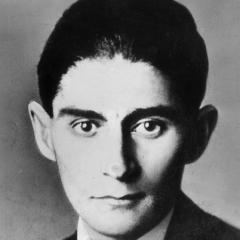
Franz Kafka
Franz Kafka

Franz Kafka (July 3, 1883 - June 3, 1924) was an important German-language novelist of the 20th century, known for his unique literary style and profound philosophical thoughts. His works, often themed around loneliness, alienation, and existentialism, have had a profound impact on literature and philosophy. more

You May Also Like

“The Infinite It was always dear to me, this solitary hill, and this hedgerow here, that closes out my view, from so much of the ultimate horizon. But sitting here, and watching here, in thought, I create interminable spaces, greater than human silences, and deepest quiet, where the heart barely fails to terrify. When I hear the wind, blowing among these leaves, I go on to compare that infinite silence with this voice, and I remember the eternal and the dead seasons, and the living present, and its sound, so that in this immensity my thoughts are drowned, and shipwreck seems sweet to me in this sea.”

“In the world of the dreamer there was solitude: all the exaltations and joys came in the moment of preparation for living. They took place in solitude. But with action came anxiety, and the sense of insuperable effort made to match the dream, and with it came weariness, discouragement, and the flight into solitude again. And then in solitude, in the opium den of remembrance, the possibility of pleasure again. What was she seeking to salvage from the daily current of living, what sudden revulsions drove her back into the solitary cell of the dream?”

“You are at my side, dear friends, and God is everywhere. Yet ultimately we are alone, making our way home by the candle of the heart. The light is steady and sure but extends only far enough to see the next step. Many times the light seems to go out. But another light, one held by a stranger or friend, a book or a song, a blackbird or a wild flower, comes close enough so that we can see our path by its light. And in time we realize that the light we have borrowed was always our own.”

“As minhas primeiras emoções tinham sido a melancolia mais pura e a compaixão mais sincera, mas na mesma proporção em que o desamparo de Bartleby crescia na minha fantasia, aquela melancolia se transformava em medo, e a compaixão, em repulsa. É tão verdadeiro e ao mesmo tempo tão terrivel o fato de que, ao vermos ou presenciarmos a miséria, os nossos melhores sentimentos são despertados até um cer to ponto; mas, em certos casos especiais, não passam disso. Erram os que afirmam que é devido apenas ao egoísmo inerente ao coração humano. Na verdade, provém de uma certa impotência em remediar um mal excessivo e orgânico. Para uma pessoa sensivel, a piedade é quase sempre uma dor. Quando afinal percebe que tal piedade não significa um socorro eficaz, o bom senso compele a alma a desvencilhar-se dela. O que vi naquela manhã convenceu-me de que o escrivão era vítima de um mal inato e incurável. Eu podia dar esmolas ao seu corpo, mas o seu corpo não lhe doía; era a sua alma que sofria, e ela estava fora do meu alcance.”