Quotessence
Home / Quotes / Quote by Erich Fromm

Quote by Erich Fromm

“Although there are certain needs, such as hunger, thirst, sex, which are common to man, those drives which make for the differences in men's characters, like love and hatred, the lust for power and the yearning for submission, the enjoyment of sensuous pleasure and the fear of it, are all products of the social process. The most beautiful as well as the most ugly inclinations of man are not part of a fixed and biologically given human nature, but result from the social process which creates man. In other words, society has not only a suppressing function - although it has that too - but it has also a creative function.”

Quote by Erich Fromm

Work

Escape from Freedom

This book explores the complexities of human psychology, delving into the nature of freedom and its impact on individuals. It examines the various aspects of human behavior and the quest for autonomy, offering insights into the human experience. more

Author

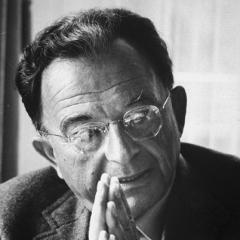
Erich Fromm
Erich Fromm

Erich Fromm, born on March 23, 1900 in Germany and died on March 18, 1980, was a renowned psychologist. His research covered a wide range of fields including anthropology, philosophy, and religion, particularly known for his studies on human psychology and interpersonal relationships. more

You May Also Like

“Actually, what does man live for?” “To think about it. Any other question?” “Yes. Why does he die just when he has done that and has become a bit more sensible?” “Some people die without having become more sensible.” “Don’t evade my question. And don’t start talking about the transmigration of souls.” “I’ll ask you something else first. Lions kill antelopes; spiders flies; foxes chickens; which is the only race in the world that wars on itself uninterruptedly, fighting and killing one another?” “Those are questions for children. The crown of creation, of course, the human being— who invented the words love, kindness, and mercy.” “Good. And who is the only being in Nature that is capable of committing suicide and does it?” “Again the human being— who invented eternity, God, and resurrection.” “Excellent,” Ravic said. “You see of how many contradictions we consist. And you want to know why we die?”

“Freedom and wildness, that which we were born into, is a grand mystery and miracle that creates a openness reserved not for barring us in but for keeping us out of cages. It is our ability to find the truth that has been a survival tool for our species both individually and corporately.”

“Most of these stories are on the tragic side. But the reader must not suppose that the incidents I have narrated were of common occurrence. The vast majority of these people, government servants, planters, and traders, who spent their working lives in Malaya were ordinary people ordinarily satisfied with their station in life. They did the jobs they were paid to do more or less competently,. They were as happy with their wives as are most married couples. They led humdrum lives and did very much the same things every day. Sometimes by way of a change they got a little shooting; but at a rule, after they had done their day's work, they played tennis if there were people to play with, went to the club at sundown if there was a club in the vicinity, drank in moderation, and played bridge. They had their little tiffs, their little jealousies, their little flirtations, their little celebrations. They were good, decent, normal people. I respect, and even admire, such people, but they are not the sort of people I can write stories about. I write stories about people who have some singularity of character which suggests to me that they may be capable of behaving in such a way as to give me an idea that I can make use of, or about people who by some accident or another, accident of temperament, accident of environment, have been involved in unusual contingencies. But, I repeat, they are the exception.”