Quotessence
Home / Quotes / Quote by Clement of Alexandria

Quote by Clement of Alexandria

“Since the fact that pleasure is not a good thing is admitted from the fact that certain pleasures are evil, by this reason good appears evil, and evil good. And then, if we choose some pleasures and shun others, it is not every pleasure that is a good thing. Similarly, also, the same rule holds with pains, some of which we endure, and others we shun. But choice and avoidance are exercised according to knowledge; so that it is not pleasure that is the good thing, but knowledge by which we shall choose a pleasure at a certain time, and of a certain kind. Now the martyr chooses the pleasure that exists in prospect through the present pain. If pain is conceived as existing in thirst, and pleasure in drinking, the pain that has preceded becomes the efficient cause of pleasure. But evil cannot be the efficient cause of good. Neither, then, is the one thing nor the other evil.”

Quote by Clement of Alexandria

Work

Volume 12. The Writings of Clement of Alexandria

Browse quotes and source details for this work. more

Author
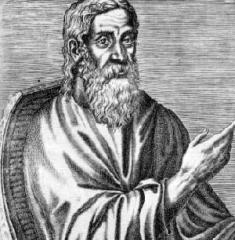
Clement of Alexandria

Clement of Alexandria was a prominent theologian in the 2nd to 3rd centuries AD, known as one of the founders of the Alexandrian Church. His writings had a profound impact on the development of Christian theology, particularly his works 'The Stromata' and 'Against the Gnostics'. more

You May Also Like

“Because...” he used to cradle his daughter in his arms every morning and often they would exchange soft nuances “...if you can dream it, if you can see it in your visions at night, if you can feel it in your soul, it’s yours! And it never really belonged to anyone else, in the first place! It was always yours!” Viera returned her scroll to the drawer and closed it, she kissed the compass around her neck and climbed into her bed under the warm quilts, the candle flame crackled and the memories of her father’s arms around her embraced her there in bed and his deep, hoarse voice resounded in her ears; “... and if you chance upon a treasure that is yours and it happens to be in the possession of someone else, it’s not very wrong to take what is yours, to take what you dreamed, what you saw in your visions at night, what you felt visit you in your spirit! Sure, it’s not lawful, but aye aye my little one, listen to me when I tell you that the best things in life are not under the laws of any sort! For which law created love? Which law created courage? The best things, the real things, are the things that are not measured by any man’s laws! Fear is the only thing that any law has ever created! And what kind of pirates would we all be if we were afraid of any of our fears, even a little!”

“Look into his eyes and tell yourself he's just a man. Tell yourself he can't know the things he says he does. He can't know your fears. But he has Alfred. He has your friend. And his eyes... you have studied the human eye. There are six eye movements that reveal motive, then fifteen variations of each one. On everyone else you face - even the most hardened criminals - the pupils contract or expand depending on emotion. Happiness, laughter, affection. The pupils open. Fear, anger, hatred, the pupils close. But not his. His pupils stay fixed, tiny points of blackness, the eyes of someone who hates everything, everyone. Eyes that let in no light, that see through the darkness, stare into you, each pupil a tiny black pearl fixed in space. A bullet coming at you. Eyes that say he's more than a man, eyes that say he knows you. No... you know what he is. Tell yourself the truth. He's just a man who fell in a vat of chemical waste. He's just a man... like you, made of bone and tissue and blood.”

“It is not simply that suppression of self is required before accurate vision can be obtained. The great artist sees his objects (and this is true whether they are sad, absurd, repulsive or even evil) in a light of justice and mercy. The direction of attention is, contrary to nature, outward, away from self which reduces all to a false unity, towards the great surprising variety of the world, and the ability so to direct attention is love.”