Quotessence
Home / Quotes / Quote by Samuel Beckett

Quote by Samuel Beckett

“There he is then, the unfortunate brute, quite miserable because of me, for whom there is nothing to be done, and he so anxious to help, so used to giving orders and to being obeyed. There he is, ever since I came into the world, possibly at his instigation, I wouldn't put it past him, commanding me to be well, you know, in every way, no complaints at all, with as much success as if he were shouting at a lump of inanimate matter.”

Quote by Samuel Beckett

Work

The Unnamable

This book explores profound themes of self-discovery and the elusive nature of personal identity, offering readers a thought-provoking narrative that challenges conventional perceptions of self and society. more

Author

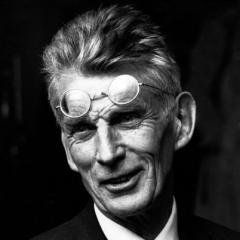
Samuel Beckett
Samuel Beckett

Samuel Beckett was an Irish novelist, playwright, and poet, widely regarded as one of the most influential writers of the 20th century. His works are characterized by their minimalist style, existential themes, and use of language. His most famous works include 'Waiting for Godot' and 'Molloy'. Beckett was awarded the Nobel Prize in Literature in 1969. more

You May Also Like

“What is the future of men who have lost sight of the past? Earl Hollsopple lived on the edge of civilization in a deserted shack for nearly forty years. His life was one beautiful night of stargazing after another, until a helicopter flies overhead, and exposing his meager world. It is a sign; it is time for him to return to civilization. Unknowingly, Earl’s journey parallels another he had deeply repressed, and that is his return from the Vietnam War. The lone survivor of a plane crash, Earl waits for rescue that never came. He is left to find his way home alone. On both his quests, old Earl and young Earl learn lessons of survival, overcoming isolation and handling conflicts; his travels teach him not just about himself, but humankind. Reaching pivotal points in both journeys, Earl meets fateful loves, leading to destinies that are ultimately intertwined. Everything in life circles until we are able to answer the riddles that plaque man and humanity. Only until we take the journey, solve the problems of our own existence, do we find our way home.”

“A goal of this book has been to tear down in some small part these barriers to understanding by attempting to shatter the “divinity of arithmetic,” through showing that even the methods, which we now take most for granted, were not given to us from on high, but were actually the result of centuries of scientific efforts on the part of our predecessors. p. 269”