Quotessence
Home / Quotes / Quote by Carl Sagan

Quote by Carl Sagan

“Look again at that (blue) dot (Earth seen from space). That's here. That's home. That's us. On it everyone you love, everyone you know, everyone you have ever heard of, every human being who ever was, lived out their lives...There is perhaps no better demonstration of the folly of human conceits than this distant image of our tiny world. To me, it underscores our responsibility to deal more kindly with one another, and to preserve and cherish the pale blue dot, the only home we've ever known.”

Quote by Carl Sagan

Work

Pale Blue Dot: A Vision of the Human Future in Space

This book delves into the possibilities of human expansion into space, reflecting on the implications and significance of our existence in the vastness of the universe. more

Author
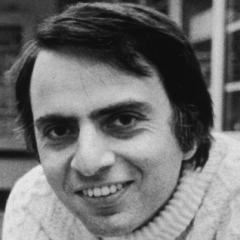
Carl Sagan
Carl Sagan

Carl Sagan was an American astronomer, cosmologist, author, and science communicator, born on November 9, 1934, in Brooklyn, New York. He is renowned for his profound research into the cosmos and his dedication to popularizing science. Sagan proposed numerous theories about the origin of the universe and life, and he made complex scientific knowledge accessible to the public with his unique perspective and clear, engaging writing style. more

You May Also Like

“So many people live within unhappy circumstances and yet will not take the initiative to change their situation because they are conditioned to a life of security, conformity, and conservatism, all of which may appear to give one peace of mind, but in reality nothing is more damaging to the adventurous spirit within a man than a secure future. The very basic core of a man's living spirit is his passion for adventure. The joy of life comes from our encounters with new experiences and hence there is no greater joy than to have an endlessly changing horizon, for each day to have a new and different sun.”

“...making relationships led to the historic intertribal agreements with the U.S. government to protect the cultural landscape of the Bears Ears as the first tribally focused national monument. Five different tribes nurtured relationships with the federal government to forever protect an earthly gift to be held in common. This was a transformative step toward healing a long history of colonial taking. That hopeful model of Indigenous economics was abruptly curtailed when Donald Trump reversed the decision and instead conveyed those sacred rights to a private uranium-mining company. It took an election to reverse it.”

“The universe—or at least the sentient constituents of it—comes to know itself through hermeneutic mediation. Put more personally, we come to know—and even become—ourselves through interacting with the world. You would not be able to recognize your own face if you had never seen it mirrored in a reflective surface or photographed.... Moreover, in very basic ways, we are permeable, such that with every breath and every meal we are constantly exchanging matter with our surroundings. All of this should begin to put pressure on the commonsense bifurcation between mental inside and physical outside.”

“Truth is simple, Lies are complex. Light is simple, Darkness is complex. Curiosity is simple, Conspiracy is complex. Acceptance is simple, Discrimination is complex. Peace is simple, war is complex. Love is simple, hate is complex.”

“We have contributed to the initiation of a new science which, as I have said, embraces technical developments with great possibilities for good and for evil. We can only hand it over into the world that exists about us, and this is the world of Belsen and Hiroshima. We do not even have the choice of suppressing these new technical developments. They belong to the age, and the most any of us can do by suppression is to put the development of the subject into the hands of the most irresponsible and most venal of our engineers. The best we can do is to see that a large public understands the trend and the bearing of the present work, and to confine our personal efforts to those fields, such as physiology and psychology, most remote from war and exploitation. As we have seen, there are those who hope that the good of a better understanding of man and society which is offered by this new field of work may anticipate and outweigh the incidental contribution we are making to the concentration of power (which is always concentrated, by its very conditions of existence, in the hands of the most unscrupulous). I write in 1947, and I am compelled to say that it is a very slight hope.”