Quotessence
Home / Quotes / Quote by Thomas Hobbes

Quote by Thomas Hobbes

“So that in the nature of man, we find three principal causes of quarrel: First, Competition; Secondly, Dissidence; Thirdly, Glory. The first, maketh men invade for Gain; the second, for Safety; and the third, for Reputation. The first use Violence, to make themselves Masters of other men's persons, wives, children and cattle; the second, to defend them; the third, for trifles, as a word, a smile, a different opinion, and any other sign of undervalue, either direct in their Persons, or by reflexion in their Kindred, their Friends, their Nation, their Profession, or their Name.”

Quote by Thomas Hobbes

Work

Leviathan

Leviathan is a seminal work in political philosophy, examining the relationship between the ruler and the ruled, the nature of government, and the social contract. It argues for the absolute power of the sovereign and the necessity of a strong central authority to maintain order and stability in society. more

Author

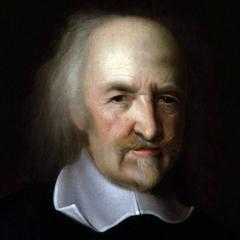
Thomas Hobbes
Thomas Hobbes

Thomas Hobbes, a British philosopher, politician, historian, economist, and writer, was born on April 5, 1588, in Wiltshire, and died on December 4, 1679, in Oxford, England. Hobbes is considered one of the most important philosophers of the 17th century, known for his profound analysis of the state, society, and human behavior. more

You May Also Like

“The Japanese fought to win - it was a savage, brutal, inhumane, exhausting and dirty business. Our commanders knew that if we were to win and survive, we must be trained realistically for it whether we liked it or not. In the post-war years, the U.S. Marine Corps came in for a great deal of undeserved criticism in my opinion, from well-meaning persons who did not comprehend the magnitude of stress and horror that combat can be. The technology that developed the rifle barrel, the machine gun and high explosive shells has turned war into prolonged, subhuman slaughter. Men must be trained realistically if they are to survive it without breaking, mentally and physically.”

“1. Bangladesh.... In 1971 ... Kissinger overrode all advice in order to support the Pakistani generals in both their civilian massacre policy in East Bengal and their armed attack on India from West Pakistan.... This led to a moral and political catastrophe the effects of which are still sorely felt. Kissinger’s undisclosed reason for the ‘tilt’ was the supposed but never materialised ‘brokerage’ offered by the dictator Yahya Khan in the course of secret diplomacy between Nixon and China.... Of the new state of Bangladesh, Kissinger remarked coldly that it was ‘a basket case’ before turning his unsolicited expertise elsewhere. 2. Chile.... Kissinger had direct personal knowledge of the CIA’s plan to kidnap and murder General René Schneider, the head of the Chilean Armed Forces ... who refused to countenance military intervention in politics. In his hatred for the Allende Government, Kissinger even outdid Richard Helms ... who warned him that a coup in such a stable democracy would be hard to procure. The murder of Schneider nonetheless went ahead, at Kissinger’s urging and with American financing, just between Allende’s election and his confirmation.... This was one of the relatively few times that Mr Kissinger (his success in getting people to call him ‘Doctor’ is greater than that of most PhDs) involved himself in the assassination of a single named individual rather than the slaughter of anonymous thousands. His jocular remark on this occasion—‘I don’t see why we have to let a country go Marxist just because its people are irresponsible’—suggests he may have been having the best of times.... 3. Cyprus.... Kissinger approved of the preparations by Greek Cypriot fascists for the murder of President Makarios, and sanctioned the coup which tried to extend the rule of the Athens junta (a favoured client of his) to the island. When despite great waste of life this coup failed in its objective, which was also Kissinger’s, of enforced partition, Kissinger promiscuously switched sides to support an even bloodier intervention by Turkey. Thomas Boyatt ... went to Kissinger in advance of the anti-Makarios putsch and warned him that it could lead to a civil war. ‘Spare me the civics lecture,’ replied Kissinger, who as you can readily see had an aphorism for all occasions. 4. Kurdistan. Having endorsed the covert policy of supporting a Kurdish revolt in northern Iraq between 1974 and 1975, with ‘deniable’ assistance also provided by Israel and the Shah of Iran, Kissinger made it plain to his subordinates that the Kurds were not to be allowed to win, but were to be employed for their nuisance value alone. They were not to be told that this was the case, but soon found out when the Shah and Saddam Hussein composed their differences, and American aid to Kurdistan was cut off. Hardened CIA hands went to Kissinger ... for an aid programme for the many thousands of Kurdish refugees who were thus abruptly created.... The apercu of the day was: ‘foreign policy should not he confused with missionary work.’ Saddam Hussein heartily concurred. 5. East Timor. The day after Kissinger left Djakarta in 1975, the Armed Forces of Indonesia employed American weapons to invade and subjugate the independent former Portuguese colony of East Timor. Isaacson gives a figure of 100,000 deaths resulting from the occupation, or one-seventh of the population, and there are good judges who put this estimate on the low side. Kissinger was furious when news of his own collusion was leaked, because as well as breaking international law the Indonesians were also violating an agreement with the United States.... Monroe Leigh ... pointed out this awkward latter fact. Kissinger snapped: ‘The Israelis when they go into Lebanon—when was the last time we protested that?’ A good question, even if it did not and does not lie especially well in his mouth. It goes on and on and on until one cannot eat enough to vomit enough.”