“I hate inconstancy—I loathe, detest, Abhor, condemn, abjure the mortal made Of such quicksilver clay that in his breast No permanent foundation can be laid; Love, constant love, has been my constant guest, And yet last night, being at a masquerade, I saw the prettiest creature, fresh from Milan, Which gave me some sensations like a villain. But soon Philosophy came to my aid, And whisper’d, ‘Think of every sacred tie!’ ‘I will, my dear Philosophy!’ I said, ‘But then her teeth, and then, oh, Heaven! her eye! I’ll just inquire if she be wife or maid, Or neither—out of curiosity.’ ‘Stop!’ cried Philosophy, with air so Grecian (Though she was masqued then as a fair Venetian); ‘Stop!’ so I stopp’d.—But to return: that which Men call inconstancy is nothing more Than admiration due where nature’s rich Profusion with young beauty covers o’er Some favour’d object; and as in the niche A lovely statue we almost adore, This sort of adoration of the real Is but a heightening of the ‘beau ideal.’ ’Tis the perception of the beautiful, A fine extension of the faculties, Platonic, universal, wonderful, Drawn from the stars, and filter’d through the skies, Without which life would be extremely dull; In short, it is the use of our own eyes, With one or two small senses added, just To hint that flesh is form’d of fiery dust. Yet ’tis a painful feeling, and unwilling, For surely if we always could perceive In the same object graces quite as killing As when she rose upon us like an Eve, ’Twould save us many a heartache, many a shilling (For we must get them any how or grieve), Whereas if one sole lady pleased for ever, How pleasant for the heart as well as liver! The heart is like the sky, a part of heaven, But changes night and day, too, like the sky; Now o’er it clouds and thunder must be driven, And darkness and destruction as on high: But when it hath been scorch’d, and pierced, and riven, Its storms expire in water-drops; the eye Pours forth at last the heart’s blood turn’d to tears, Which make the English climate of our years.”
Quote by Lord Byron
Work
Lord Byron's Don Juan is a sprawling epic poem written in ottava rima, composed over several years until the author's death. Unlike traditional portrayals of Don Juan as a predatory seducer, Byron's protagonist is depicted as a handsome but largely unwitting figure who is seduced by others and drifts through a variety of amorous and picaresque encounters. The poem blends comedy, romance, and sharp social satire, targeting hypocrisy in politics, religion, and society. It ranges across settings from Spain to Greece, Turkey, Russia, and England, offering a panoramic view of early 19th-century European mores. The work is noted for its digressive style, witty narrator, and irreverent tone, and it remains one of the most celebrated examples of Romantic satire. more
Author
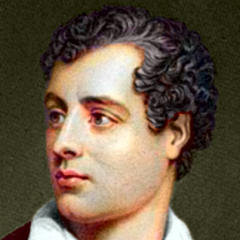
Lord Byron, born on January 22, 1788, and died on April 19, 1824, was a prominent English Romantic poet. His poetry is characterized by its strong personality and passion, and has had a profound impact on literature. more
You May Also Like
“The poem should provide that break, that vision into reality which relieves and makes alive.”
“A poetry of longing: not for escape, but for a greater reality.”
“We're not going to split the heart of reality: not until the third semester.”