Quotessence
Home / Quotes / Quote by Alfred Lord Tennyson

Quote by Alfred Lord Tennyson

“On either side the river lie Long fields of barley and of rye, That clothe the wold and meet the sky; And through the field the road runs by To many-towered Camelot.”

Quote by Alfred Lord Tennyson

Author
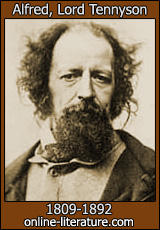
Alfred Lord Tennyson

Alfred Lord Tennyson was a prominent British Romantic poet known for his poetry that depicted nature, love, and heroism. His works, including 'In Memoriam A.H.H.' and 'Ulysses', are celebrated for their beauty and depth of emotion. more

You May Also Like

“With the blanket pulled up all the way to her chest, and the silence that still pervaded her every breath, she could definitely have been mistaken for a Victorian heroine; the Lily Maid, thought Marjan, on her way out of Camelot's reign. Tennyson's poem had been a favorite of Marjan's when she was younger; she had learned it in high school in Tehran, during a particularly spirited semester of English literature. Still, it took a minute for her to remember the story's fateful outcome: the Lady of Shalott had not made it alive out of the fabled kingdom; she had left on her death barge, floating on a dark river.”

“Our birth is but a sleep and a forgetting: The Soul that rises with us, our life's Star, Hath had elsewhere its setting, And cometh from afar: Not in entire forgetfulness, And not in utter nakedness, But trailing clouds of glory do we come From God, who is our home: Heaven lies about us in our infancy! William Wordsworth - Ode: Intimations of Immortality from Recollections of Early Childhood”

“The “Warrior Ethos” emphasizes placing the mission first, not accepting defeat, and being disciplined physically and mentally. Why? Because an American Soldier is a “guardian of freedom and the American way of life.”

“She passed under the ivy-grown lych-gate and walked between the yew trees. The graves were clustered together in groups, as if they had secrets to share and were turning over-the-shoulder eyes on incomers. The newly mown grass was cadmium green oil paint squeezed straight from the tube. Stella leaned on the railings as she read the inscriptions on William and Dorothy's graves. The light made the lettering crisp and brought out the purples and golds of the lichens. Shadows bowed the head of the lamb on Dora Quillinan's gravestone; the trees beyond were full of the trilling of blackbirds, and lines of Wordsworth's "Lucy" poem came into Stella's mind. "No motion has she now, no force, she neither hears nor sees," she whispered. "Rolled round in earth's diurnal course, with rocks, and stones, and trees."”