“The master-economist must possess a rare combination of gifts. He must reach a high standard in several different directions and must combine talents not often found together. He must be mathematician, historian, statesman, philosopher - in some degree. He must contemplate the particular in terms of the general, and touch abstract and concrete in the same flight of thought. He must study the present in the light of the past for the purposes of the future. No part of man's nature or his institutions must lie entirely outside his regard. He must be purposeful and disinterested in a simultaneous mood; as aloof and incorruptible as an artist, yet sometimes as near the earth as a politician.”
Quote by John Maynard Keynes
Author
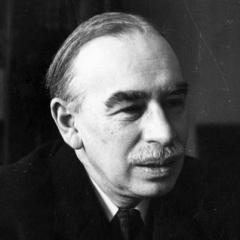
John Maynard Keynes
John Maynard Keynes, born on June 5, 1883, was a prominent British economist whose work had a profound impact on the field of economics, particularly in the area of macroeconomics. His theories advocating for government intervention to stabilize the economy gained widespread application during the Great Depression of the 1930s. more
You May Also Like
“The science of public happiness was how Keynes saw his work as an economist.”
Source: Universal Man: The Lives of John Maynard Keynes
Source: An Invisible Thread
Source: The Economic Consequences of the Peace
Source: Universal Man: The Lives of John Maynard Keynes
Source: Universal Man: The Lives of John Maynard Keynes
“At present", Keynes said in 1926, "everything is politics, and nothing policies.”
Source: Universal Man: The Lives of John Maynard Keynes
“Weintraub was an excellent student of both microtheory as well as Keynes’s General Theory.”