Quotessence
Home / Quotes / Quote by John Maynard Keynes

Quote by John Maynard Keynes

“The war has ended with every one owing every one else immense sums of money. Germany owes a large sum to the Allies, the Allies owe a large sum to Great Britain, and Great Britain owes a large sum to the United States. The holders of war loan in every country are owed a large sum by the States, and the States in its turn is owed a large sum by these and other taxpayers. The whole position is in the highest degree artificial, misleading, and vexatious. We shall never be able to move again, unless we can free our limbs from these paper shackles.”

Quote by John Maynard Keynes

Work

The Economic Consequences of the Peace

This book delves into the financial and economic repercussions of the Treaty of Versailles, offering an in-depth examination of its impact on the global economy. more

Author
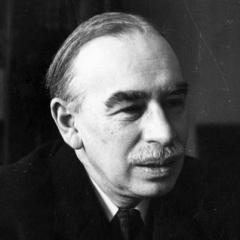
John Maynard Keynes
John Maynard Keynes

John Maynard Keynes, born on June 5, 1883, was a prominent British economist whose work had a profound impact on the field of economics, particularly in the area of macroeconomics. His theories advocating for government intervention to stabilize the economy gained widespread application during the Great Depression of the 1930s. more

You May Also Like

“Instead of using their vastly increased material and technical resources to build a wonder-city, they built slums; and they thought it right and advisable to build slums because slums, on the test of private enterprise, "paid", whereas the wonder-city would, they thought, have been an act of foolish extravagance, which would, in the imbecile idiom of the financial fashion, have "mortgaged the future"; though how the construction to-day of great and glorious works can impoverish the future, no man can see until his mind is beset by false analogies from an irrelevant accountancy.”

“Keynes concluded that citizens both rich and poor would have to be led gradually out of capitalism, a base and repugnant system of morals. His fellow liberals in the 1920s debated the morality and efficacy of capitalism, as well as the correctness of the view that, as one Liberal politician put it, “man’s primary concern is to satisfy in ever ampler degree his physical needs.” For Keynes, this might be human nature, but his entanglement with Bateson and Pearson had immersed him in the notion that biological nature was malleable. Greed would be driven out not just by education but by the eugenic cultivation of “special talents.” It would be replaced by “some of the most sure and certain principles of religion and traditional virtue—that avarice is a vice, that the exaction of usury is a misdemeanour, and the love of money is detestable, that those walk most truly in the paths of virtue and sane wisdom who take least thought for the morrow.” In the meantime, however, Keynes conceded capitalism’s efficacy. In order to improve productivity to the point where everyone’s needs could be easily satisfied, the coming century still demanded devotion to the god of greed. The goal of the next hundred years of capitalism would be its own extirpation.”

“Sometime in the early 1920s, Keynes outlined a book he planned to call “Essays on the Economic Future of the World” (figure 3).101 The chapter titles mostly represent the issues—inequality, agricultural prices, the singular circumstances of the nineteenth century—that occupied him throughout the decade, and whose resolution constituted his various versions of the Liberal platform. Population, the third chapter, was always at the top of his agendas for the next Liberal government. The concluding chapter, however, is the more enigmatic “Education, Eugenics and Φυσει δουλοι.” Keynes took the phrase “Φυσει δουλοι” (phusei douloi), “slaves by nature,” from the first book of Aristotle’s Politics. It is with the qualities of human beings that Aristotle begins: “One that can foresee with his mind is naturally ruler and naturally master, and one that can [work] with his body is subject and naturally a slave.” For Aristotle, an enlightened polity recognizes that these two kinds of people are bound by their mutual interest, and social stability requires that both embrace their natural and symbiotic relationship. Keynes, envisioning a new kind of relationship between state and citizen, had in mind a similar symbiosis, but one in which the eugenic cultivation of talent might reshape rather than harden existing social strata.”

“It would take expert navigators, like economists, to steer the world through the purgatory of capitalism and arrive at a future not just of leisure but also of morality. To ensure that human beings would be able to seize their opportunity for an ethical society, one devoted to good ends and rid of foul means, society would have to concern itself with both quality and quantity of population. As long as there was un- satisfied need, Keynes said in 1928, it would “remain reasonable to be economically purposive for others after it has ceased to be reasonable for oneself.” Here was the objective of Keynes’s idiosyncratic eugenics, one that connected the ethics of obligation to plans for social and economic management. Only when the condition of wantlessness “has become so general that the nature of one’s duty to one’s neighbour is changed” would progress truly have been made”

“In the last chapter of the /General Theory, /quoted above,^35 he [Keynes] falls into the fallacy of supposing that there is some kind of /neutral /policy that a Government can pursue, to maintain effective demand in general, without having any influence upon any particular demand for anything. The Government has to undertake “the task of adjusting to one another the propensity to consume and the inducement to invest” but everything else is best left to “the free play of economic forces.”^36 This is a metaphysical conception as unseizable as /abstract labour /or /total utility. /What is a policy which /merely /adjusts the demand for investable resources to the supply? To increase effective demand when it threatens to flag, various means can be used: to reduce taxation or to shift the burden from those most likely to increase their consumption to those most likely to reduce their savings; to foster competition so as to reduce profit margins; to increase subsidies or outlays on social services — all means which tend to reduce inequalities in consumption. Or Government expenditure on investment can be increased, directly or through nationalized industries, or reductions in taxation and credit policy can be used to encourage private investment. Contrariwise, when effective demand seems excessive, taxes to discourage consumption, credit restriction and reduced Government expenditure can be brought into play. And all this has to be worked out so as to preserve the balance of trade at some level or other, as well as to preserve employment. What is a /neutral /policy? What mixture of these means is it that leaves private enterprise unaffected in content and acts only on the quantity? [pp. 89-90]”