Quotessence
Home / Quotes / Quote by Karen Armstrong

Quote by Karen Armstrong

“Auschwitz was a dark epiphany, providing us with a terrible vision of what life is like when all sense of the sacred is lost and the human being--whoever he or she may be--is no longer revered as an inviolable mystery.”

Quote by Karen Armstrong

Work

The Case for God

This book delves into the debate on the existence of God, examining various arguments and philosophical viewpoints to provide a comprehensive analysis of the topic. more
Author

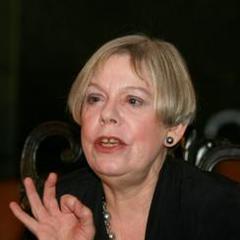
Karen Armstrong
Karen Armstrong

Karen Armstrong, born on November 14, 1944, is a renowned author and religious scholar. Her works cover a range of fields including religious history, philosophy, and ethics, and are praised for their insightful and accessible writing style as well as her respect for religious diversity. more

You May Also Like

“The history of philosophy, and perhaps especially of moral, social and political philosophy, is there to prevent us from becoming too readily bewitched. The intellectual historian can help us to appreciate how far the values embodied in our present way of life, and our present ways of thinking about those values, reflect a series of choices made at different times between different possible worlds. This awareness can help to liberate us from the grip of any one hegemonal account of those values and how they should be interpreted and understood. Equipped with a broader sense of possibility, we can stand back from the intellectual commitments we have inherited and ask ourselves in a new spirit of enquiry what we should think of them.”

“It may take a decade or two before the extent of Shakespeare's collaboration passes from the graduate seminar to the undergraduate lecture, and finally to popular biography, by which time it will be one of those things about Shakespeare that we thought we knew all along. Right now, though, for those who teach the plays and write about his life, it hasn't been easy abandoning old habits of mind. I know that I am not alone in struggling to come to terms with how profoundly it alters one's sense of how Shakespeare wrote, especially toward the end of his career when he coauthored half of his last ten plays. For intermixed with five that he wrote alone, Antony and Cleopatra, Coriolanus, The Winter's Tale, Cymbeline, and The Tempest, are Timon of Athens (written with Thomas Middleton), Pericles (written with George Wilkins), and Henry the Eighth, the lost Cardenio, and The Two Noble Kinsmen (all written with John Fletcher).”

“Intellectual activity in a culture is not a one-way flow between the great minds and passive recipients; it is a discourse, a complex marketplace-like conglomeration of intellectual exchanges involving many participants all trying to manipulate the ideas available to them in order to explain, justify, lay blame for, or otherwise make sense of what is happening around them. Everyone, not just the great minds, participates in this complicated process.”

“It is surely the following kinds of question that would need to be posed: What types of knowledge do you want to disqualify in the very instant of your demand: 'Is it a science'? Which speaking, discoursing subjects -which subjects of experience and knowledge - d you then want to 'diminish' when you say: 'I who conduct this discourse am conducting a scientific discourse, and I am a scientist'? Which theoretical-political avant garde do you want to enthrone in order to isolate it from all the discontinuous forms of knowledge that circulate about it? When I see you straining to establish the scientificity of Marxism I do not really think that you are demonstrating once and for all that Marxism has a rational structure and that therefore its propositions are the outcome of verifiable procedures; for me you are doing something altogether different, you are investing Marxist discourses and those who uphold them with the effects of a power which the West since Medieval times has attributed to science and has reserved for those engaged in scientific discourse.”

“In the history of the world, we have left our footprints by our unique stories.”