Quotessence
Home / Quotes / Quote by Samuel Beckett

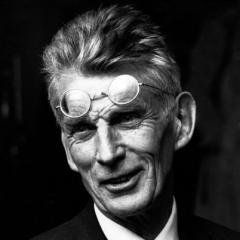
Quote by Samuel Beckett

“How, in such conditions, can I write (to consider only the manual aspect of that bitter folly)? I don't know. I could know. But I shall not know. Not this time. It is I who write, who cannot raise my hand from my knee. It is I who think (just enough to write), whose head is far. I am Matthew and I am the angel - I who came before the cross, before the sinning: came into the world, came here.”

Quote by Samuel Beckett

Work

The Unnamable

This book explores profound themes of self-discovery and the elusive nature of personal identity, offering readers a thought-provoking narrative that challenges conventional perceptions of self and society. more

Author

Samuel Beckett
Samuel Beckett

Samuel Beckett was an Irish novelist, playwright, and poet, widely regarded as one of the most influential writers of the 20th century. His works are characterized by their minimalist style, existential themes, and use of language. His most famous works include 'Waiting for Godot' and 'Molloy'. Beckett was awarded the Nobel Prize in Literature in 1969. more

You May Also Like

“For a long moment, he held her gaze without speaking, simply letting the impact of words sink in, before adding rapidly, as though he wished to get it over with as quickly as possible, "I won't deny that you're beautiful. No mirror could tell you otherwise. But there are beautiful women for the buying in any brothel in London. Oh yes, and the ballrooms, too, if one has the proper price. It wasn't your appearance that caught me. It was the way you put me down in the gallery at Sibley Court." Vaughn's lips curved in a reminiscent smile. "And the way you tried to bargain with me after." "Successfully bargained," Mary corrected. "That," replied Lord Vaughn, "is exactly what I mean. Has anyone ever told you that you haggle divinely? That the simple beauty of your self-interest is enough to bring a man to his knees?" Mary couldn't in honesty say that anyone had. Vaughn's eyes were as hard and bright as silver coins. "Those are the reasons I want you. I want you for your cunning mind and your hard heart, for your indomitable spirit and your scheming soul, for they're more honest by far than any of the so-called virtues." "The truest poetry is the most feigning?" Mary quoted back his own words to him. "And the most feigning is the most true.”

“Non poteva più credere in certi valori, da quando sapeva che si vive meglio ignorandoli. Il peccato non la spaventava più. Non è vero che l’anima pesa dopo il peccato: pesa nell’incertezza di compierlo; poi diviene consuetudine di vita. Certi princìpi resistono finché non comprendiamo che si può farne a meno. L’unico guaio quando ti giuochi la vita a va o spacca – è che, se va male, resti a sbrigartela sola.”

“Question : IF LIFE IS A BLISSFUL COSMIC PLAY, THEN WHY ARE ALL BEINGS SUFFERING? Osho : You, please, forget about all beings. You don't know. I'm not suffering. You may be suffering; don't talk about all beings. You don't even know yourself. How can you know the other? Just talk about yourself, because things are already much too complicated. When you start talking about all, you will make it almost impossible for yourself to understand the thing. Just you will do. Say only this: "Why am I suffering? If life is a blissful cosmic play, then why am I suffering?" -- only this much will do. Forget about all beings -- that is none of your business. If they want to suffer let them suffer. You, please, decide only for yourself. Even that is too much, not easy. Why are you suffering? The ego suffers. The whole is a cosmic play; it is beautiful. It is a tremendous celebration -- moment to moment, moving to higher and higher peaks. You are suffering because you are not part of it. The ego is never part of the whole; the ego tries to be separate. The ego tries to have its own plans, to have its own ideas, to have its own goals. That's why you are suffering. If you become part of the whole there is no suffering. Suddenly you start floating with the stream. You are no longer moving upstream. You are no longer even swimming, because then too there is effort. You are just floating with the stream: wheresoever it leads, there is the goal. You have dropped private goals; you have accepted the destiny of the whole. Then you live easily, you die easily. There is no resistance. Resistance is suffering -- and you cannot win against the whole. So every moment you resist you fail, you suffer. Try to live without your ego, and there is no more suffering. Suffering is an attitude; it is not an actuality. You fall ill: you immediately start fighting with illness; suffering arises. If you accept it, suffering disappears. Then you know that God wills this; there must be some point in it. It must be needed for your growth. You ask me if life is a blissful cosmic play, then WHY... then why is there suffering. There is suffering because you are still not part of the cosmic play. You have your own small drama, and you want to play it. You are not part of the whole; you are trying to create a small world of your own. Every ego creates its own world, that's the problem. Float with the whole, and suffering disappears. Suffering is symptomatic: it shows you must be fighting the whole, that's all. You are not suffering for your sins committed in the past; you are suffering for the sin that you are continuing right now, committing right now. The sin is simple: to fight, not to accept. The word "sin" is beautiful. It comes from a root which means "to separate." The word "sin" itself comes from a root which means to separate: you are separated, that is the only sin. Just the opposite is the concept of Patanjali -- He insists on "yoga," to be joined together. ..sin means to be separate; yoga means to be joined together again. If you are joined together again with the whole, there is no suffering. The more you go far away from the whole, the more you suffer. The more you are, the more you will suffer.”

“On Resurrection Day your body testifies against you. Your hand says, “I stole money.” Your lips, “I said meanness.” Your feet, “I went where I shouldn’t.” Your genitals, “Me too.” They will make your praying sound hypocritical. Let the body’s doings speak openly now, without your saying a word, as a student’s walking behind a teacher says, “This one knows more clearly than I the way.”