Quotessence
Home / Quotes / Quote by Vasily Grossman

Quote by Vasily Grossman

“This kindness, this stupid kindness, is what is most truly human in a human being. It is what sets man apart, the highest achievement of his soul. No, it says, life is not evil! This kindness is both senseless and wordless. It is instinctive, blind. When Christianity clothed it in the teachings of the Church Fathers, it began to fade; its kernel became a husk. It remains potent only while it is dumb and senseless, hidden in the living darkness of the human heart – before it becomes a tool or commodity in the hands of preachers, before its crude ore is forged into the gilt coins of holiness. It is as simple as life itself. Even the teachings of Jesus deprived it of its strength. But, as I lost faith in good, I began to lose faith even in kindness. It seemed as beautiful and powerless as dew. What use was it if it was not contagious? How can one make a power of it without losing it, without turning it into a husk as the Church did? Kindness is powerful only while it is powerless. If Man tries to give it power, it dims, fades away, loses itself, vanishes.”

Quote by Vasily Grossman

Work

Life and Fate

Browse quotes and source details for this work. more

Author
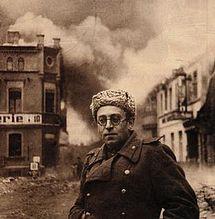
Vasily Grossman
Vasily Grossman

Vasily Grossman (December 12, 1905 – September 14, 1964) was a Soviet Jewish writer and journalist, best known for his works on World War II. Born in Berdychiv, Ukraine, he initially studied chemical engineering before turning to literature. As a war correspondent for the Red Star newspaper, he witnessed the Battle of Stalingrad and documented Nazi atrocities. His masterpiece, Life and Fate, was banned by Soviet authorities for its criticism of Stalinism and only published in the 1980s. Grossman's works explore themes of war, totalitarianism, and humanity, earning him recognition as a significant voice in 20th-century Russian literature. more

You May Also Like

“In the time we spend reeling in confusion, grasping at straws trying to piece our egos together, we forget to acknowledge some things. Society created gender roles and categorizations and lifestyles and names and titles because we fear the unknown, especially when the unknown is us. It’s as though we’re stranded in the middle of an ocean, but we were promised the current would bring us back ashore. We’re given all we need on the life raft. As far as we can see, we’re being led back, slowly. We don’t know when we’ll approach the shore, but all evidence points to the fact that we will. But we don’t spend our time looking around, enjoying the view, seeing who came with us, and riding out the waves. We sit and panic about what we’re doing and why we came here. It doesn’t matter where we started because we may never know. It matters where we’re going, because that, we do. We begin and we end. We’ve seen one, so there’s only one other option.”

“To get from the tangible to the intangible (which mature artists in any medium claim as part of their task) a paradox of some kind has frequently been helpful. For the photographer to free himself of the tyranny of the visual facts upon which he is utterly dependent, a paradox is the only possible tool. And the talisman paradox for unique photography is to work "the mirror with a memory" as if it were a mirage, and the camera is a metamorphosing machine, and the photograph as if it were a metaphor…. Once freed of the tyranny of surfaces and textures, substance and form [the photographer] can use the same to pursue poetic truth" (Minor White, Newhall, 281).”

“The nature of atheism merits clarification on two further points which involve less common ideas about theism. The first involves the idea of 'God' which is metaphorical — for example, a theist who believes in 'God' as a principle of conscience or morality. This 'God' exists in a person’s mind and it is not something which atheists will dispute. Atheists agree that gods exist as ideas in people’s minds; the disagreement lies over whether any gods actually exist independently of human beliefs. Those are the gods which atheists disbelieve in or deny. The second type of theism involves gods that exist as physical objects: stones, trees, rivers, or even the universe itself. Believers treat these objects are their gods, but do atheists reject their existence? Of course not — but how do they then remain atheists? The point of disagreement here is whether the label 'god' communicates any information beyond the more common label of 'stone,' 'tree,' or 'universe.' If not, then as far as atheists are concerned, those objects don’t merit the extra label 'god' and they remain atheists.”

“Everything was a metaphor; all things were something other than themselves. The pain, for example, was an ocean, and he was adrift on it. His body was a city and his mind a citadel. All communications between the two seemed to have been cut, but within the keep that was his mind he still had power. The part of his consciousness that was telling him the pain did not hurt, and that all things were like other things, was like...like...he found it hard to think of a comparison. A magic mirror, maybe.”

“Trees are like people and give the answers to the way of Man. They grow from the top down. Children, like treetops, have flexibility of youth, and sway more than larger adults at the bottom. They are more vulnerable to the elements, and are put to the test of survival by life's strong winds, rain, freezing cold, and hot sun. Constantly challenged. As they mature, they journey down the tree, strengthening the family unit until one day they have become big hefty branches. In the stillness below, having weathered the seasons, they now relax in their old age, no longer subject to the stress from above. It's always warmer and more enclosed at the base of the tree. The members remain protected and strong as they bear the weight and give support to the entire tree. They have the endurance.”