Quotessence
Home / Quotes / Quote by Pope Boniface VIII

Quote by Pope Boniface VIII

“We declare, say, define, and pronounce that none of those existing outside the Catholic Church, not only pagans, but also Jews and heretics and schismatics, can have a share in life eternal; but that they will go into the eternal fire which was prepared for the devil and his angels, unless before death they are joined with her; and that so important is the unity of this ecclesiastical body that only those remaining within this unity can profit by the Sacraments of the Church unto salvation, and they alone can receive an eternal recompense for their fasts, their almsgivings, their other works of Christian piety, and the duties of a Christian soldier. No one, let his almsgiving be as great as it may, no one, even if he pour out his blood for the Name of Christ, can be saved, unless he remains within the bosom and the unity of the Catholic Church.”

Quote by Pope Boniface VIII

Work

Unam Sanctam

Browse quotes and source details for this work. more

Author
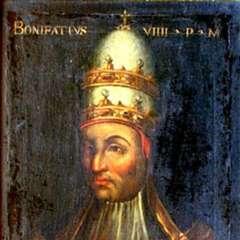
Pope Boniface VIII
Pope Boniface VIII

Pope Boniface VIII (born Benedetto Caetani, c. 1235 – October 11, 1303) was the 192nd Pope of the Roman Catholic Church, serving from 1294 to 1303. A member of the Italian Caetani noble family, he was known for his legal expertise and diplomatic skills. Boniface VIII is remembered for his fierce defense of papal authority against secular rulers, most notably King Philip IV of France. He issued the famous papal bull Unam Sanctam in 1302, declaring papal supremacy over all secular monarchs. His conflict with Philip IV over taxation rights led to his arrest and humiliation at Avignon in 1303, after which he died shortly thereafter. Boniface VIII is considered the last major representative of medieval papal temporal power. more

You May Also Like

“Let us point out, in concluding this brief outline, that Satan's masterstroke is to have succeeded in sowing disobedience to all Tradition through obedience." This special insight elucidates why the coming battle between Rome and this one Archbishop became inevitable. His Excellency Marcel Lefebvre had been granted the divine sagacity to see through the demonic shell game being played by the modern Church officials - he saw that the game was fixed and discerned how it was fixed, and therefore he refused to enter the contest. Obedience is certainly a virtue, but no one can compel you to obey an unjust command. Besides, as St. Thomas Aquinas makes clear, faith is a higher virtue than obedience. No one can compel you to be obedient to a command to give up or destroy your faith, much less the faith of others if you are a churchman who has taken a vow to pass on that faith complete, whole and undefiled.”

“The Sacrifice of Cavalry cannot be transformed, the Sacrifice of the Last Supper cannot be transformed - for there was a Sacrifice at the Last Supper - we cannot transform this Sacrifice into a simple, commemorative meal, a simple repast, at which a memory is recalled, this is not possible. To do such a thing would be to destroy the whole of our Religion, to destroy the most precious thing which Our Lord has given us here on earth, the immaculate and divine treasure which He put into the hands of His Church, which He made a priestly Church . . . (sermon of May 25, 1975)”

“The statement clearly shows the refusal of the Vatican II papacy to use its authority; things happen "automatically", and those who act bring judgement on themselves (but only on the side of tradition; modernist and progressive churchmen just go on their crazy way with an occasional "tut-tut" from Rome; they are moving in the right direction, only running too fast).”

“Bishop Mamie made clear the reason for his action: ". . . we shall continue to demand that the faithful as well as the clergy accept and apply all the orientation and decisions of the Second Vatican Council, all the teachings of John XXIII and of Paul VI, all the directives of the secretariats instituted by the Council, including the new liturgy." What of the "orientations and teachings" of earlier Councils? What of all the "teachings" of earlier popes and the "directives" of previous secretariats? What of the tradition liturgy, the prayer of the Church for many centuries? Into the dust bin of history with them and do not look back. No Marxist committed to historical inevitability and the utopia future could be more exacting. The new belief was rooted in progress, the only truth was the necessity of change. Onward! Out with the Old Church, in with the New!”

“The consecration ceremony usually begins with the "mandate", the commission from Rome approving the event. No such mandate came from Pope John Paul II, a pope with no interest in continuing the traditional Roman Catholic Church, apart from his strong stance against certain modern social violations - birth control, abortion, divorce, homosexuality - his opposition to these practices centered more on his view of the innate dignity of man than the traditional teachings of the Church. The mandate for these consecrations could only come from those earlier popes of tradition, from Eternal Rome, who would have gladly approved the Archbishop's actions to insure the continuity of tradition and the salvation of souls.”

“The question weighed on him and continued to weigh more heavily on him: Should he consecrate bishops? The Archbishop prayed for a sign. Admittedly, Our Lord had spoken clearly that a corrupt generation asks for a sign, but this request was out of necessity and of a different kind. The sign would have to be this - the corruption has become so widespread, the Church is in such a perilous state, the episcopacy is so cowardly and inert that no one else is willing to act. Should action be taken? Then the sign came, clear to those with eyes to see and ears to hear. The Sovereign Pontiff's modernist brain percolated with thoughts of a panreligious peace hootenanny prayer jamboree, a staged event with such media appeal that the Holy Father's thespian heart must have beat wildly against his rib cage in anticipation. Over 130 religious leaders, Christian and non-Christian, would gather at the Basilica in Assisi on October 27, 1986, to pray, each to his own god, for world peace. For such an ecumenical extravaganza, the First Commandment could easily be overlooked. For such a display of earthly brotherhood, the solemn decrees and specific teachings of Pope Leo XIII, Pope St. Pius X, and Pope Pius XI, all of whom had condemned such gatherings and forbidden Catholic participation in such gatherings, all of their words could easily be disregarded. Besides, that was way back then and this is NOW! Mother Church herself, in the person of an ecumaniac pope, would organize the event and send out the invitations, in defiance of God, in defiance of His holy Popes.”

“Catholics are bound to submit to the Church's established teaching on faith and morals; they are not bound to submit to new attitudes and orientations of liberalized churchmen who are now saying and doing things unheard-of in the Church's entire history. Thus, Catholics have the right, even the duty, to resist this new orientation arising from the ambiguities of the Council and the opinions of the "new theology", which conflict with the perennial and infallible Magisterium. For years, Catholics have labored under the misconception that they must accept the pastoral Council, Vatican II, with the same assent of faith that they owe to dogmatic Councils. This, however, is not the case. The Council Fathers repeatedly referred to Vatican II as a pastoral Council. That is, it was a Council that dealt not with defining the Faith, but with measures in the realm of practical and prudential judgment . . . Thus, unlike a dogmatic Council, Vatican II does not demand an unqualified assent of faith. The Council's verbose and ambiguous documents are not on a par with the doctrinal pronouncements of past councils. Vatican II's novelties are not unconditionally binding on the faithful, nor did the Council itself ever say that they were. (pages 74-75)”

“The facts related in this book will convince many open-minded non-Catholics that the authenticity of Fatima is at least possible. If this can be said of outsiders, how much more convincing should the story be for Catholics? And yet, even as the story moves unbelievers towards belief, it seems to have the opposite effect on certain Vatican officials. Ironically, some of the people now least likely to believe in Fatima are among those who should be the most likely. Beliefs once central to the Catholic faith are now being abandoned not by the faithful who remain in the pews, but by some of the highest authorities in the Church. (page ix)”