Quotessence
Home / Quotes / Quote by Louise Fitzhugh

Quote by Louise Fitzhugh

Work

Harriet the Spy

This book is a classic in children's literature, chronicling the mischievous and imaginative life of Harriet M. Welsch, a young girl who embarks on a secret life as a spy. Through her observations and diary entries, readers are introduced to the complexities of friendship, family, and the challenges of growing up. more
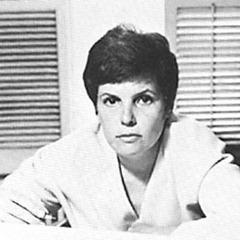
Author

Louise Fitzhugh
Louise Fitzhugh

Louise Fitzhugh (October 5, 1928 – November 19, 1974) was an American author and illustrator, best known for her classic children's novel Harriet the Spy. Born in Memphis, Tennessee, she grew up in New York City and studied art at Bard College and Cooper Union. Fitzhugh's works are noted for their psychological depth and rebellious spirit, challenging traditional gender and family norms in children's literature. Harriet the Spy, published in 1964, remains a beloved and influential book, adapted into films and TV series. She died of a brain aneurysm at age 46, but her legacy endures in the world of children's literature. more

You May Also Like

“The path is uncharted. It comes into existence moment by moment and at the same time drops away behind us. It's like riding on a train sitting backwards. We can't see where we're headed, only where we've been. This is a very encouraging teaching, because it says that the source of wisdom is whatever is going to happen to us today. The source of wisdom is whatever is happening to us right at this very instant.”

“Repetition is an important part of learning. It is a vital factor in life lessons because each recurrence tends to challenge our earlier notions, resulting in continued contemplation and greater depths of understanding.”

“When a domain reaches a point where the knowledge for skillful professional practice cannot be acquired in a decade, more or less, then several adaptive developments are likely to occur. Specialization will usually increase (as it has, for example, in medicine), and practitioners will make increasing use of books and other external reference aids in their work. Architecture is a good example of a domain where much of the information a professional requires is stored in reference works, such as catalogues of available building materials, equipment, and components, and official building codes. No architect expects to keep all of this in his head or to design without frequent resort to these information sources. In fact architecture can almost be taken as a prototype for the process of design in a semantically rich task domain. The emerging design is itself incorporated in a set of external memory structures: sketches, floor plans, drawings of utility systems, and so on. At each stage in the design process, partial design reflected in these documents serves as a major stimulus suggesting to the designer what he should attend to next. This direction to new sub-goals permits in turn new information to be extracted from memory and reference sources and another step to be taken toward the development of the design.”