“It is a common belief that we breathe with our lungs alone, but in point of fact, the work of breathing is done by the whole body. The lungs play a passive role in the respiratory process. Their expansion is produced by an enlargement, mostly downward, of the thoracic cavity and they collapse when that cavity is reduced. Proper breathing involves the muscles of the head, neck, thorax, and abdomen. It can be shown that chronic tension in any part of the body's musculature interferes with the natural respiratory movements. Breathing is a rhythmic activity. Normally a person at rest makes approximately 16 to 17 respiratory incursions a minute. The rate is higher in infants and in states of excitation. It is lower in sleep and in depressed persons. The depth of the respiratory wave is another factor which varies with emotional states. Breathing becomes shallow when we are frightened or anxious. It deepens with relaxation, pleasure and sleep. But above all, it is the quality of the respiratory movements that determines whether breathing is pleasurable or not. With each breath a wave can be seen to ascend and descend through the body. The inspiratory wave begins deep in the abdomen with a backward movement of the pelvis. This allows the belly to expand outward. The wave then moves upward as the rest of the body expands. The head moves very slightly forward to suck in the air while the nostrils dilate or the mouth opens. The expiratory wave begins in the upper part of the body and moves downward: the head drops back, the chest and abdomen collapse, and the pelvis rocks forward. Breathing easily and fully is one of the basic pleasures of being alive. The pleasure is clearly experienced at the end of expiration when the descending wave fills the pelvis with a delicious sensation. In adults this sensation has a sexual quality, though it does not induce any genital feeling. The slight backward and forward movements of the pelvis, similar to the sexual movements, add to the pleasure. Though the rhythm of breathing is pronounced in the pelvic area, it is at the same time experienced by the total body as a feeling of fluidity, softness, lightness and excitement. The importance of breathing need hardly be stressed. It provides the oxygen for the metabolic processes; literally it supports the fires of life. But breath as "pneuma" is also the spirit or soul. We live in an ocean of air like fish in a body of water. By our breathing we are attuned to our atmosphere. If we inhibit our breathing we isolate ourselves from the medium in which we exist. In all Oriental and mystic philosophies, the breath holds the secret to the highest bliss. That is why breathing is the dominant factor in the practice of Yoga.”
Quote by Alexander Lowen
Work
The Voice of the Body
Browse quotes and source details for this work. more
Author
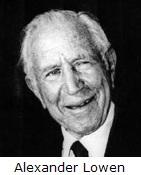
Alexander Lowen
Alexander Lowen was a significant figure in the field of 【Identity Positioning】. Born on December 23, 1910, and passing away on October 28, 2008, Lowen made a unique impact through his 【Achievements and Contributions】. His work has had a profound influence on the 【Impact and Evaluation】of his field. more
You May Also Like
“You will stay in therapy as long as you feel it is worth the time, effort and money you invest.”
Source: Bioenergetics: The Revolutionary Therapy That Uses the Language of the Body to Heal the Problems of the Mind
Source: Bioenergetics: The Revolutionary Therapy That Uses the Language of the Body to Heal the Problems of the Mind
Source: Wings
Source: Wings
Source: Wings
“It didn't matter to her that Tamani only had weak magic, he was magic.”
Source: Wings
Source: Wings
“Human locks? Please," Tamani said. "May as well leave the door open.”
Source: Illusions
Source: Wings