Quotessence
Home / Quotes / Quote by Elie Wiesel

Quote by Elie Wiesel

“Never shall I forget those flames which consumed my faith forever." "Never shall I forget that nocturnal silence which deprived me, for all eternity, of the desire to live. Never shall I forget those moments which murdered my God and my soul and turned my dreams to dust. Never shall I forget these things, even if I am condemned to live as long as God Himself. Never.”

Quote by Elie Wiesel

Book:Night

Work

Night

Night is a harrowing account of the author's survival during the Holocaust, offering a first-hand perspective on the atrocities committed during World War II. more

Author

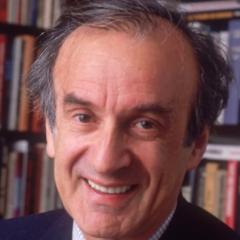
Elie Wiesel
Elie Wiesel

A renowned Jewish author and Nobel Peace Prize laureate, Elie Wiesel is known for his profound literary achievements and for recording and spreading the history of the Holocaust as a survivor. His works deeply reveal the terror of the Nazi Holocaust and the universal nature of human suffering. more

You May Also Like

“The sweet spot is a term used by audiophiles and recording engineers to describe the focal point between two sources of sound, where an individual is fully capable of hearing the audio mix the way it was intended to be heard by the musicians. Different static methods exist to broaden the area of the sweet spot. Sound engineers also refer to the sweet spot of any sound-producing body that may be captured with a microphone. Every individual instrument and voice has its own sweet spot, the perfect location to place the microphone or microphones in order to obtain the best sound. In tennis, baseball, or cricket, a given swing will result in a more powerful impact if the ball strikes the racquet or bat on the sweet spot, where a combination of factors results in a maximum response for a given amount of effort. The actual sweet spot on a racquet or bat is a very small area, where dispersing vibrations and spin in multiple directions are canceled out, resulting in a perfect contact point between incoming and outgoing energies.”

“I don’t really consider myself to be a teacher, although I understand that others do. There’s a certain restriction or reduction in that stereotype that doesn’t ring true. Especially the underlying assumption that I know something that others don’t, and my job is to give them what I know. That’s simply not true.”

“We do have some capacity to determine how things evolve, and how we evolve, individually and as a community or race. That’s a tremendous freedom and a tremendous responsibility.”

“We survive largely because of the existence and recognition of high-end qualities—compassion, integrity, courage, humility, etc. These are how we perceive spirit. Even the most cynical and fatalistic bastard will snap out of self-absorption, abuse and hopelessness when confronted by an extreme expression of any one of these qualities. (Case studies show that this also applies even to rapists and murderers, not always, but more so than any other technique or therapy.) That is, beyond belief, the desire to feel good, or even hope or despair, there does exist an essential intuitive value system in each of us. This runs through and across every culture, and even every species. I don’t believe that those intuitive values are there to fool us into occupying ourselves so as to feel good while waiting for the inevitable to happen. Nature is not so decadent. Or cynical.”

“Whether or not we personally do impact some ultimate evolution beyond ourselves, we can definitely influence what happens today. To choose to waste a day, or a lifetime, is opposed to the essential spirit of life, expressed, sacrificed for, and upheld through every perceivable interaction in nature. It’s also opposed to every human expression of spirit throughout history. We know to live up to our potential, to fulfill the trust of creation by moving forward, even if we don’t believe it or feel like it or know why.”

“The primary reason that I’m not a representative of specific groups or schools of thought is that that choice gives me the freedom to look at these groups and thoughts from the inside and the outside. I’m trying to be honest in that role—what really works here and what does not? That is, I have nothing to sell or win by any given position. I’m promoting a similar process for any person I interact with in my work, including toward me. Investment in a given idea or group tends to immediately shut down options for perception, and then choice. Prejudice, bigotry and arrogance breed from that. One is forced to think a certain way to stay within the group or thought, and then to defend against apparent opposition. This constructs and feeds the kinds of adamant separation and conflict we see so many manifestations of on every level. In many cases, it’s also the cause of deep internal conflict in most individuals, yet it isn’t really addressed.”

“There are some things that don’t function as one would assume. For example, the impulse and linear thinking associated with the search for happiness most often produce questions like, “What’s in it for me?” or “How do I get what I want?” Paradoxically, if you will, that very question pushes authentic happiness away. Now, to try to explain that to someone in such a way that they hear and are interested by the idea is going to probably involve some paradox and non-linearity.”

“Freedom and responsibility themselves are at stake. One does not find freedom or enact responsibility by surrendering to another’s conceptualization of these ideas. Living out the rules of conscience laid down by someone else for the attainment of an unquestioned goal, a freedom designed and articulated by someone else, is the surrender of human imagination and intuition. In the more extreme versions of this, we end up with a collective momentum resulting in events such as Nazi extermination of millions of Jews, the Inquisition, or similar events recently in Africa and elsewhere. That comes from allocating one’s conscience to someone else, not attending to one’s own deeper intuitive sense of right and wrong.”

“Each religion has provided a tremendous service in defining elements of conscience. They have made it possible for us to live together in a society, to work toward common goals, and to learn how to accept or tolerate relative opposition to our own opinions. I also think that this has been done much as a parent needs to provide a similar service for an adolescent. Internal and external conflict requires discipline to organize and structure some form of minimizing the chaos imposed on others.”

“There is a pivot point, however, to become an adult. That transition comes from recognizing and acting in accordance with your own deepest impulses. On the responsibility front, that means acting in harmony with your conscience, not because you’re going to be punished if you don’t, or paid for it if you do (heaven, enlightenment, salvation, or whatever), but because you know it to be right. On the freedom front, that means acquiescing to your deepest inspirations, following what truly compels you, even when it’s difficult to do so. These two principles brought together in the same time and space is what integrity is all about. And it is only through such integrity that you resolve conflict between the two of them: what you “know to do” and what you “want to do.”