Quotessence
Home / Quotes / Quote by Margaret Guenther

Quote by Margaret Guenther

“While I haven’t yet reached this state of detachment, I have spent too long with the day-to-day realities of mothering to be sentimental about it. If I am now perceived as a motherly person, I would prefer to be seen as desert amma rather than a Hallmark mommy. Most important, for good or ill, I know that my own experience in mother colors the way in which I do spiritual direction. And lest it sound as if I am excluding a large segment of the population, Meister Eckhart reminds us that we can all be mothers. While the experience of bearing nurturing a child is unique, maternal ways of being are available to all of us, men and women.”

Quote by Margaret Guenther

Work

Holy Listening: The Art of Spiritual Direction

This book delves into the profound practice of spiritual direction, offering insights into the art of listening and guiding individuals on their spiritual journeys. It examines the importance of attentive listening in fostering spiritual growth and explores various methods and approaches to spiritual direction. more

Author
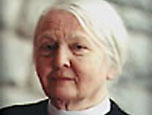
Margaret Guenther
Margaret Guenther

Margaret Guenther is an accomplished author born in 1930. Her works span a wide range of subjects, including poetry, prose, and religious literature. Guenther is known for her profound insight and beautiful prose, which have had a significant impact on the literary world. more

You May Also Like

“The Wall, a dark and sacred place, reeks of God. In the Wall we are vulnerable enough to listen to what God says - whether it is in the guise of other people’s voices, God’s voice, or serendipitous experiences. Once we believe that God is in the midst of the darkness with us, it can be a transforming place. We don’t necessarily get cured or erase our pain or become saints, but we learn how to embrace our pain, how to stay with it and learn what it is trying to teach us, how to look fear in the ace and keep moving into it. The Wall invites us each to heal.”

“The literature of apocalypse is scary stuff, the kind of thing that can give religion a bad name, because people so often use it as a means of controlling others, instilling dread by invoking a boogeyman God. ... [Apocalyptic literature] is not a detailed prediction of the future, or an invitation to withdraw from the concerns of this world. It is a wake-up call, one that uses intensely poetic language and imagery to sharpen our awareness of God's presence in and promise for the world. The word "apocalypse" comes from the Greek for "uncovering" or "revealing," which makes it a word about possibilities. And while uncovering something we'd just as soon keep hidden is a frightening prospect, the point of apocalypse is not to frighten us into submission. Although it is often criticized as "pie-in-the-sky" fantasizing, I believe its purpose is to teach us to think about "next-year-country" in a way that sanctifies our lives here and now. "Next-year-country" is a treasured idiom of the western Dakotas, an accurate description of the landscape that farmers and ranchers dwell in - next year rains will come at the right time; next year I won't get hailed out; next year winter won't set in before I have my hay hauled in for winter feeding. I don't know a single person on the land who uses the idea of "next year" as an excuse not to keep on reading the earth, not to look for the signs that mean you've got to get out and do the field work when the time is right. Maybe we're meant to use apocaly[tic literature in the same way: not as an allowance to indulge in an otherworldly fixation but as an injunction to pay closer attention to the world around us. When I am disturbed by the images of apocalypse, I find it helpful to remember the words of a fourth-centry monk about the task of reading scripture as "working the earth of the heart," for it is only in a disturbed, ploughted0up ground that the seeds we plant for grain can grow.”

“We cannot escape most of the crises in our lives, nor should we. In fact, these events frequently provide the energy for movement on our spiritual journey, even when we are stuck along the way... we ask questions about our own life. We wonder about meaning. Our present view may become inadequate. We ask deeper questions. Even joyful experiences can propel us forward.”

“A crisis can knock us off balance, making us afraid, vulnerable, and ripe for change. This also happens in our spiritual journey. We have a crisis in our faith that causes us to reconsider. It might frighten us, at least make us vulnerable. If we become bitter or too resistant, we can get very stuck. But if we let the change or crisis touch us, if we live with it and embrace it as difficult as that is, we are more likely to grow and to move eventually to another stage or spiral in our journey [of faith]. When we are most vulnerable, we have the best chance to learn and move along the way. In the midst of pain there is promise.”

“But for a Christian, there are, strictly speaking, no chances. A secret Master of Ceremonies has been at work. Christ, who said to the disciples, 'Ye have not chosen me, but I have chosen you,' can truly say to every group of Christian friends, 'You have not chosen one another, but I have chosen you for one another.' The friendship is not a reward for our discrimination and good taste in finding one another out. It is the instrument by which God reveals to each the beauties of all the others...At this feast it is He who has spread the board and it is He who has chosen the guests. it is He, we may dare to hope, who sometimes does, and always should preside. Let us not reckon without our Host.”