Quotessence
Home / Quotes / Quote by Sun Tzu

Quote by Sun Tzu

“Foreknowledge cannot be gotten from ghosts and spirits, cannot be had by analogy, cannot be found out by calculation. It must be obtained from people, people who know the conditions of the enemy.”

Quote by Sun Tzu

Work

The Art of War

This seminal work explores the principles of warfare, leadership, and conflict resolution, offering timeless insights into the nature of power and the art of winning battles without resorting to brute force. more
Author

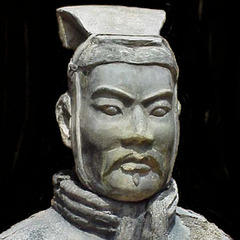
Sun Tzu
Sun Tzu

Sun Tzu, born around 544 BC and died around 496 BC, was a renowned Chinese military strategist. His military thoughts are mainly reflected in his book 'The Art of War', which is considered the classic of military strategy and has had a profound impact on various fields such as military, politics, and economics in later generations. more

You May Also Like

“However', said Dumbledore, speaking very slowly and clearly so that none of them could miss a word, 'you will find that I will only truly have left this school when none here are loyal to me. You will also find that help will always be given at Hogwarts to those who ask for it.' For a second, Harry was almost sure Dumbledore's eyes flickered toward the corner where he and Ron stood hidden.”

“You are protected, in short, by your ability to love!" said Dum-bledore loudly. "The only protection that can possibly work against the lure of power like Voldemort's! In spite of all the temptation you have endured, all the suffering, you remain pure of heart, just as pure as you were at the age of eleven, when you stared into a mir-ror that reflected your heart's desire, and it showed you only the way to thwart Lord Voldemort, and not immortality or riches. Harry, have you any idea how few wizards could have seen what you saw in that mirror? Voldemort should have known then what he was dealing with, but he did not! But he knows it now. You have flitted into Lord Voldemort's mind without damage to yourself, but he cannot possess you with-out enduring mortal agony, as he discovered in the Ministry. I do not think he understands why, Harry, but then, he was in such a hurry to mutilate his own soul, he never paused to understand the incomparable power of a soul that is untarnished and whole." "But, sir," said Harry, making valiant efforts not to sound argu-mentative, "it all comes to the same thing, doesn't it? I've got to try and kill him, or —" "Got to?" said Dumbledore. "Of course you've got to! But not because of the prophecy! Because you, yourself, will never rest until you've tried! We both know it! Imagine, please, just for a moment, that you had never heard that prophecy! How would you feel about Voldemort now? Think!" Harry watched Dumbledore striding up and down in front ol him, and thought. He thought of his mother, his father, and Sinus. He thought of Cedric Diggory. He thought of all the terrible deeds he knew Lord Voldemort had done. A flame seemed to leap inside his chest, searing his throat. "I'd want him finished," said Harry quietly. "And I'd want to do it." "Of course you would!" cried Dumbledore. "You see, the prophecy does not mean you have to do anything! But the prophecy caused Lord Voldemort to mark you as his equal. ... In other words, you are free to choose your way, quite free to turn your back on the prophecy! But Voldemort continues to set store by the prophecy. He will continue to hunt you . . . which makes it certain, really, that —" "That one of us is going to end up killing the other," said Harry. "Yes." But he understood at last what Dumbledore had been trying to tell him. It was, he thought, the difference between being dragged into the arena to face a battle to the death and walking into the arena with your head held high. Some people, perhaps, would say that there was little to choose between the two ways, but Dumble-dore knew — and so do I, thought Harry, with a rush of fierce pride, and so did my parents — that there was all the difference in the world.”

“Of course I loved you . . . and I knew that it would happen all over again . . . that where I loved, I would cause irreparable damage. I am no fit person to love . . . I have never loved without causing harm. ― J.K. Rowling, Harry Potter and the Cursed Child”

“Dumbledore's plan works well in giving Harry protection from the external danger of Voldemort. The plan also gives him an ordinary life. This ordinary life is a protection from the spiritual danger of pride, while being an aid to humility. Voldemort does not escape this danger. He has contempt for anything that makes him ordinary, such as his name Tom. He wants to be "different, separate, notorious." Harry, on the other hand, never tries to avoid his name, although the Dursleys think it a "nasty common name." He interiorises the value of being ordinary. ... singularity [is] the vice that is the opposite of accepting one's ordinariness.”