Quotessence
Home / Quotes / Quote by Simone de Beauvoir

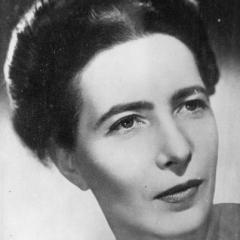
Quote by Simone de Beauvoir

“Une porte fermé, quelque chose qui guette derrière. Elle ne s'ouvrira pas si je ne bouge pas. Ne pas bouger; jamais. Arrêter le temps et la vie. Mais je sais que je bougerai. La porte s'ouvrira lentement et je verrai ce qu'il y a derrière la porte. C'est l'avenir. La porte de l'avenir va s'ouvrir. Lentement. Implacablement. Je suis sur le seuil. Il n'y a que cette porte et ce qui guette derrière. J'ai peur. Et je ne peux appeler personne au secours. J'ai peur.”

Quote by Simone de Beauvoir

Work

The Woman Destroyed

This book delves into the psychological and emotional turmoil of a woman facing personal and societal challenges, examining the complexities of identity and the impact of external forces on individual lives. more

Author

Simone de Beauvoir
Simone de Beauvoir

Simone de Beauvoir was a French writer, philosopher, feminist, and social activist. Known for her profound philosophical thoughts and her advocacy for women's status, she is one of the most influential female thinkers of the 20th century. Her works spanned various genres, including novels, philosophical essays, plays, and memoirs, with her most famous work being 'The Second Sex'. more

You May Also Like

“Whatever your opinion of frequent sexual congress, let us assume for the purpose of this study that sensual sex should provide an increase in personal happiness, which was a widely held belief during the era we are discussing. A visual expression of the data we compiled regarding the subject's sexual activity shows happiness decreasing as sexual activity increases.”

“In this hysterical phase, it was, so to speak, the femininity of man which projected itself on to woman and shaped her as an ideal figure in his image. In Romantic love, the aim was not now to conquer the woman, to seduce her, but to create her from the inside, to invent her, in some cases as achieved Utopian vision, as idealized woman , in others as femme fatale, as star - another hysterical, supernatural metaphor. The Romantic Eros can be credited with having invented this ideal of harmony, of loving fusion, this ideal of an almost incestuous form of twin beings — the woman as projective resurrection of the same, who assumes her supernatural form only as ideal of the same, an artefact doomed henceforth to l'amour or, in other words, to a pathos of the ideal resemblance of beings and sexes - a pathetic confusion which substitutes for the dual otherness of seduction. The whole mechanics of the erotic changes meaning, for the erotic attraction which previously arose out of otherness, out of the strangeness of the Other, now finds its stimulus in sameness - in similarity and resemblance. Auto-eroticism, incest? No . Rather a hypostasis of the Same. Of the same eyeing up the other, investing itself in the other, alienating itself in the other - but the other is only ever the ephemeral form of a difference which brings me closer to me. This indeed is why, with Romantic love and all its current spin-offs, sexuality becomes connected with death: it is because it becomes connected with incest and its destiny - even in banalized form (for we are no longer speaking of mythic, tragic incest here; with modern eroticism we are dealing with a secondary incestuous form - of the protection of the same in the image of the other - which amounts to a confusion and corruption of all images). We have here then, in the end, the invention of a femininity which renders woman superfluous. The invention of a difference which is merely a roundabout copulation with its double. And which, at bottom, renders any encounter with otherness impossible (it would be interesting to know whether there was not any hysterical quid pro quo from the feminine in the construction of a virile, phallic mythology; feminism being one such example of the hystericization of the masculine in woman, of the hysterical projection of her masculinity in the exact image of the hysterical projection by man of his femininity into a mythical image of woman).”