Quotessence
Home / Quotes / Quote by Swami Vivekananda

Quote by Swami Vivekananda

“Thou art That". This is the essence of Vedanta; after all its ramifications and intellectual gymnastics, you know the human soul to be pure and omniscient, you see that such superstitions as birth and death would be entire nonsense when spoken of in connection with the soul. The soul was never born and will never die, and all these ideas that we are going to die and are afraid to die are mere superstitions. [...] The Vedanta teaches men to have faith in themselves first. As certain religions of the world say that a man who does not believe in a Personal God outside of himself is an atheist, so the Vedanta says, a man who does not believe in himself is an atheist.”

Quote by Swami Vivekananda

Work

Practical Vedanta

This book delves into the philosophical and spiritual teachings of Vedanta, offering insights into its principles and practices. It aims to provide readers with a comprehensive understanding of the system, including its origins, key concepts, and methods for personal growth and enlightenment. more

Author

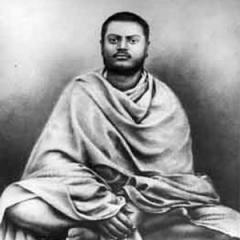
Swami Vivekananda
Swami Vivekananda

Swami Vivekananda (January 12, 1863 – July 4, 1902) was an Indian Hindu monk, philosopher, and social reformer. Born as Narendranath Datta in Kolkata, he was a chief disciple of the mystic Ramakrishna. He is best known for his historic speech at the 1893 Parliament of the World's Religions in Chicago, where he introduced Hinduism to the Western world. He founded the Ramakrishna Mission in 1897, focusing on social service, education, and interfaith harmony. His teachings emphasized self-realization, service to humanity, and the unity of all religions. He wrote extensively on yoga and Vedanta philosophy, influencing global spirituality and Indian nationalism. He died at the age of 39, leaving a lasting legacy as a bridge between Eastern and Western thought. more

You May Also Like

“I sit and ponder my existence: how I'm here, what put me here in these thoughts, these feelings, birthed from a timeless sleep, what it felt like, or rather the lack thereof, to not have been and now to 'be', and suddenly, I realize how absurd I am to exist, the fragility in my understanding of existence; I then wonder why the supernatural, the thought of other beings, of God or of gods, must be distinctly absurd - by which I am no longer sure. 'If I exist and I have made myself absurd to me, then why not they exist while merely believed absurd by me?' Perhaps it is true that in a wandering head, one full of wonders, the natural becomes supernatural and the supernatural becomes preternatural (or rational within the sights of discovery and explanation), just as the return home after a life-long journey feels, for a moment, foreign after the many experiences.”