Quotessence
Home / Quotes / Quote by Atul Gawande

Quote by Atul Gawande

“For all the differences among the eight hospitals, I was nonetheless surprised by how readily one can feel at home in an operating room, wherever it might be. Once a case was underway, it was still surgery. You still had a human being on the table with his hopes and his fears, and his body opened up to you, trusting you to do right by him. And you still had a group of people striving to work together with enough skill and commitment to warrant that trust.”

Quote by Atul Gawande

Work

The Checklist Manifesto: How to Get Things Right

In The Checklist Manifesto, surgeon and public health researcher Atul Gawande argues that in an increasingly complex world, even experts can benefit from using checklists to manage tasks and avoid mistakes. Drawing on examples from surgery, aviation, and building construction, Gawande shows how checklists help ensure consistency, communication, and reliability in high-stakes environments. The book makes a case for embracing humility and systematic procedures to achieve better outcomes, without oversimplifying the challenges of professional work. more

Author
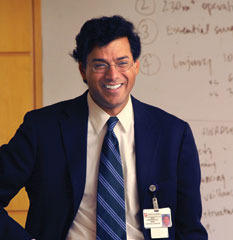
Atul Gawande
Atul Gawande

Atul Gawande is a renowned American surgeon and writer. Born on November 5, 1965, in Mumbai, India, he immigrated to the United States. Gawande is known for his expertise in surgery and his profound insights into the healthcare system. His writings cover a range of topics from surgical techniques to medical ethics, and have been well-received by readers. more

You May Also Like

“Day by day, month by month, doubt by doubt, law and order became fascism; education, constraint; work, alienation; revolution, mere sport; leisure, a privilege of class; marijuana, a harmless weed; family, a stifling hothouse; affluence, oppression; success, a social disease; sex, an innocent pastime; youth, a permanent tribunal; maturity, the new senility; discipline, an attack on personality; Christianity... and the West... and white skin...”

“As a civilization progresses, it goes through wars, pandemics, catastrophes. those that survive grow more astute, more perceptive, more advanced. Diseases are conquered, infirmity eliminated. Life spans increase. Suffering becomes largely a memory. "Meanwhile, their explorers and historians find evidence of past cultures, and cultures before that. At first it is exciting. But all they keep finding are ruins. And slowly, either through science or history, every advanced civilizations becomes aware of a disturbing possibility -- that their futures may end in ruin too. "The civilization then rushes to probe other stars, even other galaxies; it increases its research, attempting to manipulate space, time, in the hope that somewhere, someone might have found an escape, a loophole. "But eventually, the find, and solve, the mathematical equation that explains the entire universe." "I think our scientists are working on something like that too," Shizuka said. Lan shook her head. "They'll need to find the Grand Unified Theory a few more times before they can even begin to understand what 'everything' is -- sorry, I didn't mean to offend your civilization." Shizuka shrugged. "No offense taken." "Still, should your civilization survive, it will eventually find the same equation. And that will be your death sentence. For in that equation, there will be no forever, no eternity. Nothing. "And this collapse, and all its attendant despair, is the Endplague." Shizuka was puzzled. Space aliens, she could understand. Purple skin? Cute. Two elbows? Weird, but fine. Galactic warfare? Frankly, expected. Being a refugee? Of course. But how could the mere concept of mortality be enough to topple advanced civilizations? People live, people die, and so what?”