“Under the seeming disorder of the old city, wherever the old city is working successfully, is a marvelous order for maintaining the safety of the streets and the freedom of the city. It is a complex order. Its essence is intricacy of sidewalk use, bringing with it a constant succession of eyes. This order is all composed of movement and change, and although it is life, not art, we may fancifully call it the art form of the city and liken it to the dance — not to a simple-minded precision dance with everyone kicking up at the same time, twirling in unison and bowing off en masse, but to an intricate ballet in which the individual dancers and ensembles all have distinctive parts which miraculously reinforce each other and compose an orderly whole. The ballet of the good city sidewalk never repeats itself from place to place, and in any once place is always replete with new improvisations.”
Quote by Jane Jacobs
Work
This influential work challenges conventional urban planning theories of the 1950s and 1960s, particularly those advocating for large-scale clearance, superblocks, and strict separation of uses. The author draws on close observation of city streets and neighborhoods to argue that vibrant, safe, and economically diverse urban areas arise from dense, mixed-use environments with short blocks and a constant flow of pedestrians. The book critiques the principles of figures like Le Corbusier and Ebenezer Howard, as well as the policies of urban renewal that devastated many existing communities. Instead, it proposes four essential generators of urban diversity and emphasizes the importance of local knowledge, informal social networks, and the intricate ballet of street life in maintaining a healthy city. The work remains a foundational text in urban studies, planning, and sociology. more
Author
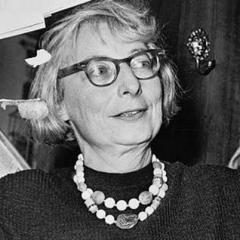
Jane Jacobs, an American journalist and urban theorist, was born on May 4, 1916, and passed away on April 25, 2006. She is renowned for her profound insights into urban life and her unique perspectives on urban planning. Her book, 'The Death and Life of Great American Cities,' had a revolutionary impact on modern urban planning. more
You May Also Like
“When planners fail to account for gender, public spaces become male spaces by default.”