Quotessence
Home / Quotes / Quote by Karen Armstrong

Quote by Karen Armstrong

“As soon as I stopped trying to exploit my literary skills to advance my career or enhance my reputation, I found that I was opening myself to the text, could lose myself to the beauty of the words and in the wisdom of the writer. It was a kind of ekstasis, an ecstasy that was not an exotic, tranced state of consciousness but, in the literal sense of the word, a going beyond self.”

Quote by Karen Armstrong

Work

The Spiral Staircase: My Climb Out of Darkness

This memoir offers a candid look into the author's life, exploring the challenges faced and the resilience shown in overcoming darkness and adversity. more

Author
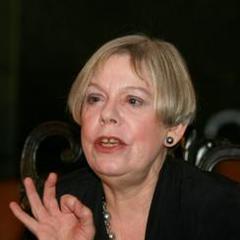
Karen Armstrong
Karen Armstrong

Karen Armstrong, born on November 14, 1944, is a renowned author and religious scholar. Her works cover a range of fields including religious history, philosophy, and ethics, and are praised for their insightful and accessible writing style as well as her respect for religious diversity. more

You May Also Like

“People tend to mistake reading and writing with living passively. Words are actions. Language ignites thoughts and channels emotions. Each sentence written by a literary master is an act of rebellion against the intolerable inadequacies and the outrageous injustices of life. Contemplative reading and writing creates channels of empathy and decreases our sense of aloneness. Many liberating social movements trace their origins back to a heart-wrenching piece of literature.”

“The act of reading will enrich your life.Become a lifelong learner and a reader.”

“Writers allow us to see ourselves more clearly, they express spiritual signposts that assist us find ourselves. Writers’ self-revelations allow us to grasp personal reflections that remain unrealized and indistinct within ourselves. Nuggets of personal perception remain veiled, until we read carefully chosen words sharing the author’s crystallized perceptions. Provocative authors resolutely tap into that robust vein of common yearning and assiduously engineer their way through humankind’s rampant library of collective neurosis. Reading a master’s scintillating prose allows our own inchoate thoughts to shape up under the splendid beam of sunlight that they cast onto pages bearing their soul’s freshly minted words. Their astutely crafted pages conveying everlasting imagery immunizes their work from the harshness of time’s relentless march forward.”

“A writer toils to combat the insufficiency plaguing his or her life. Every writer seeks to ward off the corrosive obliteration wrought by the passage of time upon memory by capturing on paper his or her present day thoughts on life. For these intrepid souls, writing not only entails a lifetime of work it also represents their very lifeblood spilled out onto sheets of virgin white paper. Writers’ inkblot of words forms a pictograph for present and future generations to view; their thoughtful elucidations speak to us from the grave. Writers’ words transcend time by creating indelible images that survive wars, famines, epidemics, and censorship. Thanks to great writers, every man, woman, or child can escape the confines of their own cloistered environment and converse with other people of every occupation and lifestyle whose communal heartbeats form the bloodstream of every city. Thanks to literary figures, each reader can peer into the depths of past generations whose eclectic filament forms the ever-evolving equitable eye in humankinds’ collective consciousness, or colloquially what we refer to as humanity.”

“An active engagement with written material through reflective thought gained by reading and writing leads to intellectual growth. A person whom fails to read and write will experience mental stagnation. Failure to cultivate ideas by exposing oneself to written material limits a person’s resources to what they see and hear. Passively reviewing external stimuli might lull a person into believing that they are actively thinking and growing. The more external stimuli a person exposes themselves to, the less time that is available for pursing mental, emotional, and spiritual growth.”

“A program of active reading and writing might be the hardest form of thinking, but it is also the most organized methodology of self-education. Reading exposes the mind to a world of ideas heretofore unimaginable and encourages the novice learner to write. Reading is a form a joint mediation and writing represents the product of several authors’ collective and collaborative minds at work.”