Quotessence
Home / Quotes / Quote by Wallace Stegner

Quote by Wallace Stegner

“That night she wrote a hasty sketch and showed it to Oliver. "It's all right," he said. "But I'd take out that stuff about Olympian mountains and the Stygian caverns of the mine. That's about used up, I should think.”

Quote by Wallace Stegner

Work

Angle of Repose

A Pulitzer Prize-winning novel that explores themes of memory, art, and the passage of time through the eyes of a sculptor and his family living in the American West during the late 19th century. more
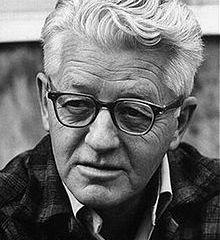
Author

Wallace Stegner
Wallace Stegner

Wallace Stegner was an influential American historian known for his extensive research on the history of the American West. His works not only documented the pioneering journey of the American West but also profoundly reflected the relationship between humans and nature. Stegner's writing style was unique and his language beautiful, which won him great popularity among readers. more

You May Also Like

“Allegorical stories of saints battling with giants, monsters and demons may be interpreted as symbolizing the Christian's fight against paganism. At Bwlch Rhiwfelen (Denbigh) St Collen fought and killed a cannibal giantess, afterwards washing away the blood-stains in a well later known as Ffynnon Gollen. In Ireland, the tales of saints slaying giant serpents may have the same meaning; alternatively they (or some of them) may refer to early sightings of genuine water monsters. St Barry banished a serpent from a mountain into Lough Lagan (Roscommon), and a holy well sprang up where the saint's knee touched the ground.”

“In the place Calliope had bled, a trail of corn sprouted behind her. She picked the two tallest corn shoots then sat beside two large, smooth stone metates for grinding. From within her husk rebozo, she pulled a mano, shucked the corn, laid it on the altar, and with the mano in both hands, she began moving with the weight of her whole body, the strength of her shoulders and back pressing down through her arms, back and forth, shearing, until the corn became a fine yellow powder. The Ancients sang her on as she worked. When the Earth has had enough, she will shake her troubles off. She will shake her troublemakers off. She scooped this and mashed it into the butter of her hands. Rolled it into a ball, flattened it again. Shaped and shaped until the corn grew into a child, who sprang from the stone of her hands, laughing. For she was finished, and sank into the earth, solid, hardened, at peace. And as her corn-made child ran from the mound to the grass below, the spirits intoned. The Earth has all the power she needs. When she decides to use her power, you will know.”

“Inside it Scylla sits and yelps with a voice that you might take to be that of a young hound, but in truth she is a dreadful monster and no one—not even a god—could face her without being terror-struck. She has twelve mis-shapen feet, and six necks of the most prodigious length; and at the end of each neck she has a frightful head with three rows of teeth in each, all set very close together, so that they would crunch any one to death in a moment, and she sits deep within her shady cell thrusting out her heads and peering all round the rock, fishing for dolphins or dogfish or any larger monster that she can catch, of the thousands with which Amphitrite teems. No ship ever yet got past her without losing some men, for she shoots out all her heads at once, and carries off a man in each mouth.”

“From The Ghost Wars- on the concept of the Torah as ancient science fiction. “Take the story of the fall of the tower of Babel. Let’s say this represents not an act of God, nor a metaphor for this planet’s diverse linguistic heritage; but a catastrophic act of terrorism by the Divisionists to sever mankind from the neural net. The internet in this situation becomes mankind’s attempt to build a physical replacement for a natural ability long lost. Think of it as a wooden leg or a pacemaker.”

“A shock of light. Unbelievable light. Blood orange swallowing the Albuquerque evening. A pulling in, taking back, reclaiming something stolen. Halfway home from her Saturday-morning lecture, Calliope Santiago drove across the river toward West Mesa and the Sleeping Sisters, ancient cinder-cone volcanoes in the distance marking the stretch of desert where she lived. Only now she could see no farther than two feet ahead of her from the blinding light, the splotches in her eyes bursting like bulbs in an antique camera. She blinked, not sure what she was seeing. She meant to cover her eyes. Meant to shield her sight.”

“On the map of you, my fingers could always find the green hills, Wales. Cool waters and a shore of white chalk. The ancient part of you carved out of stone in a prayerful circle, sacrosanct. Your spine's a ridge I'd die climbing. If I could spread it out on my desk, I'd find the corner of your mouth where it pinches with my fingers, and I'd smooth it away and you'd be marked with the names of saints like all the old maps. I get the nomenclature now- saints' names belong to miracles”

“The rocks pummeled her belly. Something rose in her throat and when she tried to speak, from her mouth she dislodged a rock. She was made of rocks. She couldn’t move from the fossilized casing she’d once called her body. Heat crackled nearby. A conversation wove through the fire. A child’s sweaty body curled at her lap, chest rhythms of breathing, up and down, pressing against her. 'I didn’t want to believe it was happening again.”