Quotessence
Home / Quotes / Quote by Mary Wollstonecraft

Quote by Mary Wollstonecraft

Work

Maria: or, The Wrongs of Woman

Browse quotes and source details for this work. more

Author
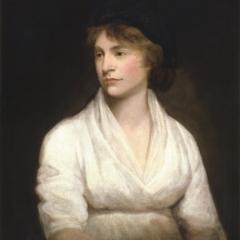
Mary Wollstonecraft
Mary Wollstonecraft

Mary Wollstonecraft, born on April 27, 1759, and died on September 10, 1797, was an influential English writer, philosopher, and feminist. She is best known for her work 'A Vindication of the Rights of Woman', which challenged the gender roles and social structures of her time. more

You May Also Like

“We have been raised to fear the yes within ourselves, our deepest cravings. But, once recognized, those which do not enhance our future lose their power and can be altered. The fear of our desires keeps them suspect and indiscriminately powerful, for to suppress any truth is to give it strength beyond endurance. The fear that we cannot grow beyond whatever distortions we may find within ourselves keeps us docile and loyal and obedient, externally defined.”

“In terms of understanding the patriarchal struggle for control of women's bodies, the issue of blood is a major preoccupation. For not only did women bleed every month, from girlhood for all over their adult lives; every stage of their journey as women, every passage from one state to the next (menarche, defloration, childbirth) was also marked by the flow of blood with its frighteningly ambivalent signal of both life and death. The greater the danger the stronger the taboo. All these "courses" of women's lives have triggered an intricate and often savage set of myths, beliefs and customs in which the containment of cultural fears overrode any personal concern for the female who was ostensibly the cause and center of it all.”

“Domination was not absolute, systems were imperfect, there was still too much room to maneuver - control could not be based on an organ that men could not control. There had to be more - an idea of imminent, eternal maleness that was not physical, visible, fallible; one that was greater than all women because greater than man; whose power was omnipotent and unquestionable - one god, God the father, who man now invented in his own image.”

“To women, therefore, the effect was broadly the same, however the message of male supremacy came packaged. All these systems - Judaism, Confucianism, Buddhism, Christianity and Islam - were presented to them as holy, the result of divine inspiration transmitted from a male power to males empowered for this purpose, thereby enshrining maleness itself as power.”

“All patriarchies, in fact, only succeeded by colonizing, indeed cannibalizing the forms, emblems and sacred objects of the Goddess they were purporting to root out. Much recent theological scholarship has been devoted to recovering what in ages past every schoolgirl knew: that the Great Goddess in her threefold incarnation (maiden, mother and wisewoman) lies behind the Christian trinity, that her immature aspect of moon maiden became the Virgin Mary, and so on.”

“I believe that the phrase ‘obligatory reading’ is a contradiction in terms; reading should not be obligatory. Should we ever speak of 'obligatory pleasure'? Pleasure is not obligatory, pleasure is something we seek. 'Obligatory happiness'! [...] If a book bores you, leave it; don’t read it because it is famous, don’t read it because it is modern, don’t read a book because it is old. If a book is tedious to you, leave it, even if that book is 'Paradise Lost' — which is not tedious to me — or 'Don Quixote' — which also is not tedious to me. But if a book is tedious to you, don't read it; that book was not written for you. Reading should be a form of happiness, so I would advise all possible readers of my last will and testament—which I do not plan to write— I would advise them to read a lot, and not to get intimidated by writers' reputations, to continue to look for personal happiness, personal enjoyment. It is the only way to read.”

“For whatever needs were answered by the new patriarchies as they grew, throve and put on beef, they were bot the deeper needs of the female sex. Of course, there were attractions - there had to be, for women to swallow the ideological bait without perceiving either the hook or the poisonous lead weighing it down. None of these systems could have been imposed on women against their will. There had to be consent from the women members of each tribe, township or race proselytized by the zealots of the new gods, at some level. Which of them, though, presented with the first appealing package of function and freedom, could have known what she was consenting to for herself and all her female descendants for the next 2,000 years?”