Quotessence
Home / Quotes / Quote by George Bernard Shaw

Quote by George Bernard Shaw

Author

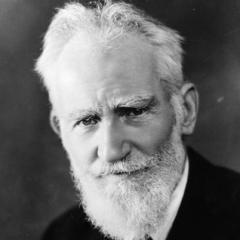
George Bernard Shaw
George Bernard Shaw

George Bernard Shaw (July 26, 1856 - November 2, 1950) was an Irish-British playwright, critic, and socialist. He is renowned for his satirical and witty dramatic works. more

You May Also Like

“He opened his mouth and closed it again. There was so much more he wanted to say to her, but Alistair knew that he couldn’t. He could remember her. He could remember this: the two of them standing side by side. Only it wasn’t this moment, but another, centuries before. Two sides of the same coin. It made him want to shout in excitement; it made him want to hide in shame. She doesn’t remember.”

“They were turning now, panning past the Sandias, the black-green crags and rocky faces, the ribbon of road leading to the white crest. Amina looked down on Albuquerque, the light bouncing off the sprawling tile of houses and pools, the cars running along the highways like busy insects. She imagined all of it gone, undone, erased back to 1968, when the city was nothing but eighty miles of hope huddling in a desert storm. She imagined Kamala on the tarmac, walking toward a life in the desert, her body pulled forward by faith and dirty wind.”

“All of these dancers. Imagine that each one is an atom, forming molecules of dancers fore each category: Traditional, Fancy, Grass, Jingle. You see the whole identity... Now focus on just one dancer-say, a Jingle Dress dancer...Every atom has subatomic parts. Her regalia includes a dress, belt, moccasins, and a lot of other items. Dancers don't start out with their full regalia; they get it bit by bit. Each piece is a connection to her family, her teachers, and even to ancestors generations back. If you know the story of her regalia-who and where and why each item came to be-then you know her.”

“The white conservatives aren't friends of the Negro either, but they at least don't try to hide it. They are like wolves; they show their teeth in a snarl that keeps the Negro always aware of where he stands with them. But the white liberals are foxes, who also show their teeth to the Negro but pretend that they are smiling. The white liberals are more dangerous than the conservatives; they lure the Negro, and as the Negro runs from the growling wolf, he flees into the open jaws of the "smiling" fox. The job of the Negro civil rights leader is to make the Negro forget that the wolf and the fox both belong to the (same) family. Both are canines; and no matter which one of them the Negro places his trust in, he never ends up in the White House, but always in the dog house.”

“Conservatism" in America's politics means "Let's keep the niggers in their place." And "liberalism" means "Let's keep the knee-grows in their place-but tell them we'll treat them a little better; let's fool them more, with more promises." With these choices, I felt that the American black man only needed to choose which one to be eaten by, the "liberal" fox or the "conservative" wolf-because both of them would eat him. I didn't go for Goldwater any more than for Johnson-except that in a wolf's den, I'd always known exactly where I stood; I'd watch the dangerous wolf closer than I would the smooth, sly fox. The wolf's very growling would keep me alert and fighting him to survive, whereas I might be lulled and fooled by the tricky fox. I'll give you an illustration of the fox. When the assassination in Dallas made Johnson President, who was the first person he called for? It was for his best friend, "Dicky"-Richard Russell of Georgia. Civil rights was "a moral issue," Johnson was declaring to everybody-while his best friend was the Southern racist who led the civil rights opposition. How would some sheriff sound, declaring himself so against bank robbery-and Jesse James his best friend? How would some sheriff sound, declaring himself so against bank robbery-and Jesse James his best friend? Goldwater as a man, I respected for speaking out his true convictions-something rarely done in politics today. He wasn't whispering to racists and smiling at integrationists. I felt Goldwater wouldn't have risked his unpopular stand without conviction. He flatly told black men he wasn't for them-and there is this to consider: always, the black people have advanced further when they have seen they had to rise up against a system that they clearly saw was outright against them. Under the steady lullabies sung by foxy liberals, the Northern Negro became a beggar. But the Southern Negro, facing the honestly snarling white man, rose up to battle that white man for his freedom-long before it happened in the North. Anyway, I didn't feel that Goldwater was any better for black men than Johnson, or vice-versa. I wasn't in the United States at election time, but if I had been, I wouldn't have put myself in the position of voting for either candidate for the Presidency, or of recommending to any black man to do so. It has turned out that it's Johnson in the White House-and black votes were a major factor in his winning as decisively as he wanted to. If it had been Goldwater, all I am saying is that the black people would at least have known they were dealing with an honestly growling wolf, rather than a fox who could have them half-digested before they even knew what was happening.”