Quotessence
Home / Quotes / Quote by Garrett Hardin

Quote by Garrett Hardin

“Quoting from page 308: The Competitive Exclusion Principle. No two organisms that compete in every activity can coexist indefinitely in the same environment. To coexist in time, organisms that are potentially completely competitive must be geographically isolated from each other. Otherwise, the one that is the less efficient yields to the more efficient, no matter how slight the difference. When two competing organisms coexist in the same geographical region, close examination always shows that they are not complete competitors, that one of them draws on a resource of the environment that is not available to the other. The corollary of the principle is that where there is no geographical isolation of genetically and reproductively isolated populations, there must be as many ecological niches as there are populations. The necessary condition for geographical coexistence is ecological specialization. Quoting page 86: The Exclusion Principle in biology plays a role similar to that of the Newtonian laws of motion in physics. It is a prime guide to the discovery of facts. We use the principle coupled with an axiom that is equally fundamental but which is almost never explicitly stated. We may call this the Inequality Axiom, and it states: If two populations are distinguishable, they are competitively unequal. Quoting page 87: Because of the compound-interest effect, no difference between competing populations is trivial. The slightest difference--and our acceptance of the Inequality Axiom asserts that a difference always exists--will result in the eventual extinction of one population by another. Put in another way, the Exclusion Principle tells us that two distinguishable populations can coexist in the same geographical region only if they live in different ecological worlds (thus avoiding complete competition and strict coexistence). Quoting page 88-89: Recall now the sequence of development in the process of speciation. Initially, the freshly isolated populations are nearly the same genetically; as time goes on, they diverge more and more. When they are distinguishably different, but still capable of interbreeding (if put together), we may speak of them as races. Ultimately, if the physical isolation endures long enough, they become so different from each other that interbreeding is impossible; we then say that the two populations are reproductively isolated from each other, and we speak of them as distinct species. ... What are the various possible outcomes of the speciation process, and what their relative frequencies? In the light of our assumption, it is clear that, most often, the speciation process will go no further than the formation of races before the physical isolation comes to an end and the germ plasm of the two races is melded into one by interbreeding. If, however, the speciation process continues until separate species are formed before the physical barrier breaks down, then what happens? The outcome is plainly dependent on the extent to which ecological differentiation has occurred: Do the two species occupy the same ecological niche, or not--that is, are they completely competitive? It seems probable that the degree of ecological differentiation will also increase with time spent in physical isolation. On this assumption, we would predict that, more often than not, "sister species" will be incapable of coexistence: when the physical isolation is at an end, one sister species will extinguish the other. Quoting page 253: The example illustrates the general rule that as a species becomes increasingly "successful," its struggle for existence ceases to be one of struggle with the physical environment or with other species and come to be almost exclusively competition with its own kind. We call that species most successful that has made its own kind its worst enemy. Man enjoys this kind of success.”

Quote by Garrett Hardin

Work

Nature and Man's Fate

Browse quotes and source details for this work. more

Author
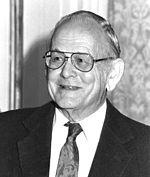
Garrett Hardin
Garrett Hardin

Garrett Hardin, an ecologist, was born on April 21, 1915, and passed away on September 14, 2003. He is renowned for his theory of the 'Tragedy of the Commons,' which explores the issue of resource overuse. more

You May Also Like

“The loss of white ethno-cultural confidence manifests itself in other ways. Among the most important is a growing unwillingness to indulge the anti-white ideology of the cultural left. When whites were an overwhelming majority, empirically unsupported generalizations about whites could be brushed off as amusing and mischievous but ultimately harmless. As whites decline, fewer are willing to abide such attacks. At the same time, white decline emboldens the cultural left, with its dream of radical social transformation.”

“Cosmopolitanism must manage the contradiction between its ethos of transcending ethnicity and its need for cultural diversity, which requires ethnic attachment. Bourne resolved this by splitting the world into two moral planes, one for a ‘parental’ majority who would be asked to shed their ethnicity and oppose their own culture, and the other for childlike minorities, who would be urged to embrace their heritage in the strongest terms.”

“It Was Never Stolen Land. It Was Bought and Paid For. Now the Indians Are Trying to Renege.” By James Fulford, December 4, 2020, VDARE [Fulford is quoting Felix S. Cohen:] Fortunately for the security of American real estate titles, the business of securing cessions of Indian titles has been, on the whole, conscientiously pursued by the Federal Government, as long as there has been a Federal Government. The notion that America was stolen from the Indians is one of the myths by which we Americans are prone to hide our real virtues and make our idealism look as hard-boiled as possible. We are probably the one great nation in the world that has consistently sought to deal with an aboriginal population on fair and equitable terms. We have not always succeeded in this effort but our deviations have not been typical. It is, in fact, difficult to understand the decisions on Indian title or to appreciate their scope and their limitations if one views the history of American land settlement as a history of wholesale robbery." The quotation is from The Legal Conscience: Selected Papers Of Felix S Cohen,1960.”

“Page 308 The Competitive Exclusion Principle. No two organisms that compete in every activity can coexist indefinitely in the same environment. To coexist in time, organisms that are potentially completely competitive must be geographically isolated from each other. Otherwise, the one that is the less efficient yields to the more efficient, no matter how slight the difference. When two competing organisms coexist in the same geographical region, close examination always shows that they are not complete competitors, that one of them draws on a resource of the environment that is not available to the other. The corollary of the principle is that where there is no geographical isolation of genetically and reproductively isolated populations, there must be as many ecological niches as there are populations. The necessary condition for geographical coexistence is ecological specialization.”

“The loss of white ethno-cultural confidence manifests itself in other ways. Among the most important is a growing unwillingness to indulge the anti-white ideology of the cultural left. When whites were an overwhelming majority, empirically unsupported generalizations about whites could be brushed off as amusing and mischievous but ultimately harmless. As whites decline, fewer are willing to abide such attacks. At the same time, white decline emboldens the cultural left, with its dream of radical social transformation. ... From a modern perspective, the most important figure to emerge from this milieu is Randolph Bourne. Viewed as a spokesman for the new youth culture in upper-middle-class New York, Bourne burst onto the intellectual scene with an influential essay in the respected Atlantic Monthly in July 1916 entitled ‘Trans-National America’. Here Bourne was influenced by Jewish-American philosopher Horace Kallen. Kallen was both a Zionist and a multiculturalist. Yet he criticized the Liberal Progressive worldview whose cosmopolitan zeal sought to consign ethnicity to the dustbin of history. Instead, Kallen argued that ‘men cannot change their grandfathers’. Rather than all groups giving and receiving cultural influence, as in Dewey’s vision, or fusing together, as mooted by fellow Zionist Israel Zangwill in his play The Melting Pot (1910), Kallen spoke of America as a ‘federation for international colonies’ in which each group, including the Anglo-Saxons, could maintain their corporate existence. There are many problems with Kallen’s model, but there can be no doubt that he treated all groups consistently. Bourne, on the other hand, infused Kallen’s structure with WASP self-loathing. As a rebel against his own group, Bourne combined the Liberal Progressives’ desire to transcend ‘New Englandism’ and Protestantism with Kallen’s call for minority groups to maintain their ethnic boundaries. The end product was what I term asymmetrical multiculturalism, whereby minorities identify with their groups while Anglo-Protestants morph into cosmopolites. Thus Bourne at once congratulates the Jew ‘who sticks proudly to the faith of his fathers and boasts of that venerable culture of his’, while encouraging his fellow Anglo-Saxons to: "Breathe a larger air . . . [for] in his [young Anglo-Saxon’s] new enthusiasms for continental literature, for unplumbed Russian depths, for French clarity of thought, for Teuton philosophies of power, he feels himself a citizen of a larger world. He may be absurdly superficial, his outward-reaching wonder may ignore all the stiller and homelier virtues of his Anglo-Saxon home, but he has at least found the clue to that international mind which will be essential to all men and women of good-will if they are ever to save this Western world of ours from suicide." Bourne, not Kallen, is the founding father of today’s multiculturalist left because he combines rebellion against his own culture and Liberal Progressive cosmopolitanism with an endorsement – for minorities only – of Kallen’s ethnic conservatism. In other words, ethnic minorities should preserve themselves while the majority should dissolve itself.”

“Page 35: The quota laws [that maintained existing ethnic proportions] of the 1920s, however, had themselves been reform achievements, supported by a broad coalition that included middle-class “Progressives” (both Republicans and Democrats), organized labor, and the most prominent African-American leaders of the day. Immigration restrictionists from the left side of the political spectrum included leaders of organized labor, prominent spokesmen for black Americans, social justice Progressives, and conservationists. They argued that uncontrolled immigration, encouraged by industrial employers seeking docile low-wage workers, flooded the national labor pool, depressed wages, worsened working conditions and tenement housing, weakened organized labor, provided the basis for the corrupt city political machines, and threatened overpopulation.”

“Quoting page 60: In the 1960s, racism was chiefly understood to mean discrimination by whites against African-Americans. But in the immigration debate of the Progressive Era, the nation’s most prominent black leaders—most notably the Republican conservative, Booker T. Washington, and the socialist intellectual, W.E.B. DuBois—supported the restrictionists. Washington, in his famous Atlanta address at the Cotton States Exposition in 1895, pleaded with industrial leaders to employ loyal, hardworking freedmen, rather than import millions of European immigrants to take the industrial jobs that otherwise might have freed native-born African-Americans from segregated misery in the rural South.”

“Quoting Page 109: An Urban Institute study found that when public school costs were included, Mexican immigrant households in Los Angeles County in 1980 cost almost twice as much in state and local government expenditures than they paid in taxes.”

“Quoting page 115: The Hispanic civil rights organizations were heavily financed by the Ford Foundation, whose president from the late 1960s through the 1970s was McGeorge Bundy, Harvard alumni veteran of the Kennedy White House and tower of the nation’s eastern liberal establishment. In 1968 Ford had created MALDEF, as a Latino version of the NAACP, with a $2.2 million founding grant. La Raza, given a similar birthing grant of $630,000 by Ford in 1968, received $1,953,700 two years later. Between 1970 and 1999, Ford gave MALDEF $27.9 million and La Raza $21.5 million. In 1981 Ford started funding LULAC, the oldest Hispanic association. Noted since its origins in Texas in 1929 for espousing patriotism, political moderation, self-help ethnic, support for English language mastery, and bourgeois civic boosterism, LULAC in the 1970s adopted the strident tone of Chicano nationalism common to La Raza and MALDEF. In 1983 the Ford Foundation, led by Ford’s first African-American president, Franklin A. Thomas, began funding the National Immigration Forum, an umbrella association modeled on the Leadership Conference on Civil Rights, to coordinate lobbying against [immigration] restrictionist organizations such as FAIR. LULAC, although joining the racialized agenda of MALDEF and La Raza in the 1970s, retained its character as a membership-based organization rooted in the Hispanic (mainly Mexican-American) community. But the constituency represented by MALDEF and La Raza was essentially the Ford Foundation and the tightly networking community of Latino political careerists.”

“When relationships have outlived their shelf life, people often realize that at some level, they are sticking it our because they once thought in the light of their divine love that the other person would change. Sorry for breaking the poetic hope here, but that doesn't happen. People are like rubber bands. They may be able to stretch from time to time and do some amazing things, but in general they are who they are. If manipulation and machinations on your side get them to behave the way you want, I will set my clock on the fact that they will return to their previous way of behaving, or they will keep faking it. To be in a relationship with someone who is not really there doesn't make sense. People who aren't cooperating feel like a project to us, like something for us to rescue or fix. Rescuing is the province of firefighters and fairy tales, but it's not real life. The stance of sticking it out in hopes of redemption is an old story and one that has wasted many lives.”