Quotessence
Home / Quotes / Quote by Lewis Carroll

Quote by Lewis Carroll

“As she listened, or seemed to listen, the whole place around her became alive with the strange creatures of her little sister’s dream. The long grass rustled at her feet as the White Rabbit hurried by—the frightened Mouse splashed his way through the neighbouring pool—she could hear the rattle of the teacups as the March Hare and his friends shared their never-ending meal, and the shrill voice of the Queen ordering off her unfortunate guests to execution—once more the pig-baby was sneezing on the Duchess’s knee, while plates and dishes crashed around it—once more the shriek of the Gryphon, the squeaking of the Lizard’s slate-pencil, and the choking of the suppressed guinea-pigs, filled the air, mixed up with the distant sobs of the miserable Mock Turtle. So she sat on, with closed eyes, and half believed herself in Wonderland, though she knew she had but to open them again, and all would change to dull reality—the grass would be only rustling in the wind, and the pool rippling to the waving of the reeds—the rattling teacups would change to tinkling sheep-bells, and the Queen’s shrill cries to the voice of the shepherd boy—and the sneeze of the baby, the shriek of the Gryphon, and all the other queer noises, would change (she knew) to the confused clamour of the busy farm-yard—while the lowing of the cattle in the distance would take the place of the Mock Turtle’s heavy sobs.”

Quote by Lewis Carroll

Work

Alice's Adventures in Wonderland

This renowned work of children's literature, written by Lewis Carroll, combines elements of fantasy and satire. The narrative follows Alice's journey through a whimsical and often nonsensical world, where she encounters a variety of strange characters such as the Cheshire Cat, the Mad Hatter, and the Queen of Hearts. The story is celebrated for its imaginative storytelling and has become a staple in Western literature. more

Author
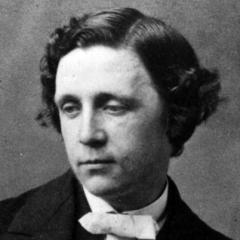
Lewis Carroll
Lewis Carroll

Lewis Carroll, born Charles Lutwidge Dodgson, was an English writer, mathematician, logician, photographer, and children's author. He is best known for his novel Alice's Adventures in Wonderland, which is celebrated for its unique imagination, rich symbolism, and humor. more

You May Also Like

“A countdown was started on my local radio show to my 18th birthday — euphemistically the date that I would be legal to sleep with,” she said. “Movie reviewers talked about my budding breasts in reviews. I understood very quickly, even as a 13-year-old, that if I were to express myself sexually I would feel unsafe and that men would feel entitled to discuss and objectify my body to my great discomfort.”

“A countdown was started on my local radio show to my 18th birthday — euphemistically the date that I would be legal to sleep with. Movie reviewers talked about my budding breasts in reviews. I understood very quickly, even as a 13-year-old, that if I were to express myself sexually I would feel unsafe and that men would feel entitled to discuss and objectify my body to my great discomfort.”

“According to what I've heard, the earth is round. But is that really true? Earth might have the shape of rock candy...but I don't really know for sure... it's not like I've actually seen the earth... in the same way, I've never actually seen most things that are considered common knowledge. common knowledge is what we take for granted,.. we base our lives around such uncertain things...”

“The word nature has many senses; but if we preserve the one which etymology justifies, and which is the most philosophical as well, nature should mean the principle of birth or genesis, the universal mother, the great cause, or system of causes, that brings phenomena to light. If we take the word nature in this sense, it may be said that Lucretius, more than any other man, is the poet of nature. Of course, being an ancient, he is not particularly a poet of landscape. He runs deeper than that; he is a poet of the source of landscape, a poet of matter. A poet of landscape might try to suggest, by well-chosen words, the sensations of light, movement, and form which nature arouses in us; but in this attempt he would encounter the insuperable difficulty which Lessing long ago pointed out, and warned poets of: I mean the unfitness of language to render what is spatial and material; its fitness to render only what, like language itself, is bodiless and flowing,—action, feeling, and thought. It is noticeable, accordingly, that poets who are fascinated by pure sense and seek to write poems about it are called not impressionists, but symbolists; for in trying to render some absolute sensation they render rather the field of association in which that sensation lies, or the emotions and half-thoughts that shoot and play about it in their fancy. They become—against their will, perhaps—psychological poets, ringers of mental chimes, and listeners for the chance overtones of consciousness. Hence we call them symbolists, mixing perhaps some shade of disparagement in the term, as if they were symbolists of an empty, super-subtle, or fatuous sort. For they play with things luxuriously, making them symbols for their thoughts, instead of mending their thoughts intelligently, to render them symbols for things. A poet might be a symbolist in another sense,—if he broke up nature, the object suggested by landscape to the mind, and reverted to the elements of landscape, not in order to associate these sensations lazily together, but in order to build out of them in fancy a different nature, a better world, than that which they reveal to reason. The elements of landscape, chosen, emphasized, and recombined for this purpose, would then be symbols for the ideal world they were made to suggest, and for the ideal life that might be led in that paradise. Shelley is a symbolic landscape poet in this sense. To Shelley, as Francis Thompson has said, nature was a toy-shop; his fancy took the materials of the landscape and wove them into a gossamer world, a bright ethereal habitation for new-born irresponsible spirits. Shelley was the musician of landscape; he traced out its unrealized suggestions; transformed the things he saw into the things he would fain have seen. In this idealization it was spirit that guided him, the bent of his wild and exquisite imagination, and he fancied sometimes that the grosser landscapes of earth were likewise the work of some half-spiritual stress, of some restlessly dreaming power. In this sense, earthly landscape seemed to him the symbol of the earth spirit, as the starlit crystal landscapes of his verse, with their pensive flowers, were symbols in which his own fevered spirit was expressed, images in which his passion rested.”