Quotessence
Home / Quotes / Quote by Herman Melville

Quote by Herman Melville

“In life, the visible surface of the Sperm Whale is not the least among the many marvels he presents. Almost invariably it is all over obliquely crossed and re-crossed with numberless straight marks in thick array, something like those in the finest Italian line engravings. But these marks do not seem to be impressed upon the isinglass substance above mentioned, but seem to be seen through it, as if they were engraved upon the body itself. Nor is this all. In some instances, to the quick, observant eye, those linear marks, as in a veritable engraving, but afford the ground for far other delineations. These are hieroglyphical; that is, if you call those mysterious cyphers on the walls of pyramids hieroglyphics, then that is the proper word to use in the present connexion. By my retentive memory of the hieroglyphics upon one Sperm Whale in particular, I was much struck with a plate representing the old Indian characters chiselled on the famous hieroglyphic palisades on the banks of the Upper Mississippi. Like those mystic rocks, too, the mystic-marked whale remains undecipherable.”

Quote by Herman Melville

Work

Moby-Dick or, The Whale

Browse quotes and source details for this work. more

Author
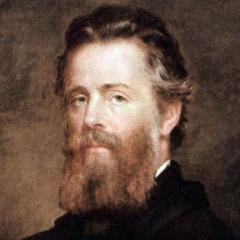
Herman Melville
Herman Melville

Herman Melville was a renowned 19th-century American novelist known for his profound psychological descriptions and unique literary style. His masterpiece, 'Moby-Dick', is considered a classic of American literature. more

You May Also Like

“Very often conditions are recorded as observable "under thy fingers" [...] Among such observations it is important to notice that the pulsations of the human heart are observed.”

“Speechlessness, however, affirmed in the diagnosis, is carefully based on the facts of the examination, as we see by rendering the statements concerned, just as they stand in examination and diagnosis: "If thou examinest a man having a wound in the temple, ...; if thou ask of him concerning his malady and he speak not to thee; ...; thou shouldst say concerning him, 'One having a wound in his temple, ... (and) he is speechless'.”

“The attention given to the side of the head which has received the injury, in connection with a specific reference to the side of the body nervously affected, is in itself evidence that in this case the ancient surgeon was already beginning observations on the localization of functions in the brain.”

“We could argue that the ancient Egyptians were positively constrained by their hieroglyphic system of writing to express abstract qualities in a crudely physical way. Against such an interpretation, it is important to bear in mind that language is not simply the vehicle of expression of a given mentality, it actually is that mentality giving expression to itself. The very structures of language are the articulation of the mentality. We should be wary of thinking that the ancient Egyptian mind was “really” like ours, but was constrained by the hieroglyphic script. Rather, the hieroglyphic script was the medium most appropriate for the articulation of the ancient Egyptian mentality. Far from being crude, it reflected richly symbolic modes of conceiving and relating to both the physical and the psychic spheres of existence. It has already become apparent that these two spheres were not experienced as separated from each other—as we today tend to experience them. It is now necessary to go further, and seriously consider the idea that psychic attributes were indeed experienced as “situated” in various parts of the body. The pictorial character of the hieroglyphic form of writing made possible a quite effortless translation of this experience into the written word. For the hieroglyphic script, because it was pictorial, had not yet created a division between concrete and abstract, between “outer” and “inner.” And it had not done so just because the ancient Egyptian mentality had not done so.”

“[...] we have in our treatise a series of fifty-seven examinations, almost exclusively of injuries of the human body forming a group of observations furnishing us with the earliest known nucleus of fact regarding the anatomy, physiology and pathology of the human body. Crude and elementary as they are, the method by which they were collected was scientific, and these observations, together with the diagnoses and the explanatory commentary in the ancient glosses, form the oldest body of science now extant.”