Quotessence
Home / Quotes / Quote by Daniel Defoe

Quote by Daniel Defoe

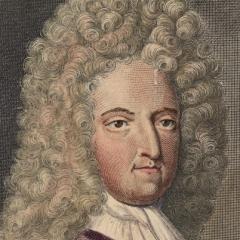
“I added, that whoever the woman was that had an estate, and would give it up to be the slave of a great man, that woman was a fool, and must be fit for nothing but a beggar; that it was my opinion a woman was as fit to govern and enjoy her own estate without a man as a man was without a woman; and that, if she had a mind to gratify herself as to sexes, she might entertain a man as a man does a mistress; that while she was thus single she was her own, and if she gave away that power she merited to be as miserable as it was possible that any creature could be. Roxana: The Fortunate Mistress (1724)”

Quote by Daniel Defoe

Book:Roxana

Work

Roxana

Browse quotes and source details for this work. more

Author

Daniel Defoe
Daniel Defoe

Daniel Defoe, an English writer born on September 13, 1660, and died on April 24, 1731. His works covered a wide range of genres, including adventure novels, political satire, and philosophical thinking, with his most famous work being 'Robinson Crusoe'. Defoe's works have had a profound impact on literature. more

You May Also Like

“If a woman is interested in her own struggle into identity and power, then she will be interested in other women. The lives of these, and other women, show me what a woman can do even without formal power, education, or rights, in a world dominated by men. They are inspirational examples of the strength of the female spirit.”

“In much the same way, motherhood has become the essential female experience, valued above all others: giving life is where it's at. "Pro-maternity" propaganda has rarely been so extreme. They must be joking, the modern equivalent of the double constraint: "Have babies, it's wonderful, you'll feel more fulfilled and feminine than ever," but do it in a society in freefall in which waged work is a condition of social survival but guaranteed to no one, and especially not to women. Give birth in cities where accommodation is precarious, schools have surrendered the fight and children are subject to the most vicious mental assault through advertising, TV, internet, fizzy drink manufacturers and so on. Without children you will never be fulfilled as a woman, but bringing up kids in decent conditions is almost impossible.”

“Women, even the most oppressed among us, do exercise power. These powers can be used to advance feminist struggle. Forms of power held by exploited and oppressed groups are described in Elizabeth Janeway's important work Powers of the Weak. One of the most significant forms of power held by the weak is "the refusal to accept the definition of oneself that is put forward by the powerful". Janeway call this the "ordered use of the power to disbelieve". She explains: It is true that one may not have a coherent self-definition to set against the status assigned by the established social mythology, and that is not necessary for dissent. By disbelieving, one will be led toward doubting prescribed codes of behaviour, and as one begins to act in ways that can deviate from the norm in any degree, it becomes clear that in fact there is not just one right way to handle or understand events. Women need to know that they can reject the powerful's definition of their reality --- that they can do so even if they are poor, exploited, or trapped in oppressive circumstances. They need to know that the exercise of this basic personal power is an act of resistance and strength. Many poor and exploited women, especially non-white women, would have been unable to develop positive self-concepts if they had not exercised their power to reject the powerful's definition of their reality. Much feminist thought reflects women's acceptance of the definition of femaleness put forth by the powerful. Even though women organizing and participating in feminist movement were in no way passive, unassertive, or unable to make decisions, they perpetuated the idea that these characteristics were typical female traits, a perspective that mirrored male supremacist interpretation of women's reality. They did not distinguish between the passive role many women assume in relation to male peers and/or male authority figures, and the assertive, even domineering, roles they assume in relation to one another, to children, or to those individuals, female or male, who have lower social status, who they see as inferiors, This is only one example of the way in which feminist activists did not break with the simplistic view of women's reality s it was defined by powerful me. If they had exercised the power to disbelieve, they would have insisted upon pointing out the complex nature of women's experience, deconstructing the notion that women are necessarily passive or unassertive.”

“Their point of resemblance to each other and their difference from so many American women, lay in the fact that they were all happy to exist in a man's world--they preserved their individuality through men and not by opposition to them. They would all three have made alternatively good courtesans or good wives not by the accident of birth but through the greater accident of finding their man or not finding him.”