Quotessence
Home / Quotes / Quote by Bell Hooks

Quote by Bell Hooks

“Women, even the most oppressed among us, do exercise power. These powers can be used to advance feminist struggle. Forms of power held by exploited and oppressed groups are described in Elizabeth Janeway's important work Powers of the Weak. One of the most significant forms of power held by the weak is "the refusal to accept the definition of oneself that is put forward by the powerful". Janeway call this the "ordered use of the power to disbelieve". She explains: It is true that one may not have a coherent self-definition to set against the status assigned by the established social mythology, and that is not necessary for dissent. By disbelieving, one will be led toward doubting prescribed codes of behaviour, and as one begins to act in ways that can deviate from the norm in any degree, it becomes clear that in fact there is not just one right way to handle or understand events. Women need to know that they can reject the powerful's definition of their reality --- that they can do so even if they are poor, exploited, or trapped in oppressive circumstances. They need to know that the exercise of this basic personal power is an act of resistance and strength. Many poor and exploited women, especially non-white women, would have been unable to develop positive self-concepts if they had not exercised their power to reject the powerful's definition of their reality. Much feminist thought reflects women's acceptance of the definition of femaleness put forth by the powerful. Even though women organizing and participating in feminist movement were in no way passive, unassertive, or unable to make decisions, they perpetuated the idea that these characteristics were typical female traits, a perspective that mirrored male supremacist interpretation of women's reality. They did not distinguish between the passive role many women assume in relation to male peers and/or male authority figures, and the assertive, even domineering, roles they assume in relation to one another, to children, or to those individuals, female or male, who have lower social status, who they see as inferiors, This is only one example of the way in which feminist activists did not break with the simplistic view of women's reality s it was defined by powerful me. If they had exercised the power to disbelieve, they would have insisted upon pointing out the complex nature of women's experience, deconstructing the notion that women are necessarily passive or unassertive.”

Quote by Bell Hooks

Work

Feminist Theory: From Margin to Center

This book delves into the development of feminist theory, tracing its journey from being a marginalized field to a central and influential part of intellectual and societal discussions. more

Author
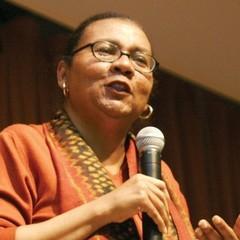
Bell Hooks
Bell Hooks

Bell Hooks, born Gloria Jean Watkins, is an American author, scholar, and activist. Her work primarily focuses on issues of race, gender, and social justice, particularly on feminist and black feminist thought. Hooks' works include novels, poetry, academic writings, and autobiographies, and her writing style is beloved by readers for its profound social insight and desire for change. more

You May Also Like

“Their point of resemblance to each other and their difference from so many American women, lay in the fact that they were all happy to exist in a man's world--they preserved their individuality through men and not by opposition to them. They would all three have made alternatively good courtesans or good wives not by the accident of birth but through the greater accident of finding their man or not finding him.”

“You’re not really mad that I’m not having children. In fact, I would probably love to one day. You’re mad that I’m expressing autonomy of choice. You’re mad that I’m considering other options. You’re mad that I don’t view that as my ultimate potential. You’re mad that I dare be selfish enough to make choices based on my best interest, something women are not supposed to do. You’re mad that I consider it a choice, and that I, a woman, am exercising choice. You’re not mad that I’m not having babies. You’re mad because I’m acting like a man.”

“They asked me to tell you what it was like to be twenty and pregnant in 1950 and when you tell your boyfriend you’re pregnant, he tells you about a friend of his in the army whose girl told him she was pregnant, so he got all his buddies to come and say, “We all fucked her, so who knows who the father is?” And he laughs at the good joke…. What was it like, if you were planning to go to graduate school and get a degree and earn a living so you could support yourself and do the work you loved—what it was like to be a senior at Radcliffe and pregnant and if you bore this child, this child which the law demanded you bear and would then call “unlawful,” “illegitimate,” this child whose father denied it … What was it like? […] It’s like this: if I had dropped out of college, thrown away my education, depended on my parents … if I had done all that, which is what the anti-abortion people want me to have done, I would have borne a child for them, … the authorities, the theorists, the fundamentalists; I would have born a child for them, their child. But I would not have born my own first child, or second child, or third child. My children. The life of that fetus would have prevented, would have aborted, three other fetuses … the three wanted children, the three I had with my husband—whom, if I had not aborted the unwanted one, I would never have met … I would have been an “unwed mother” of a three-year-old in California, without work, with half an education, living off her parents…. But it is the children I have to come back to, my children Elisabeth, Caroline, Theodore, my joy, my pride, my loves. If I had not broken the law and aborted that life nobody wanted, they would have been aborted by a cruel, bigoted, and senseless law. They would never have been born. This thought I cannot bear. What was it like, in the Dark Ages when abortion was a crime, for the girl whose dad couldn’t borrow cash, as my dad could? What was it like for the girl who couldn’t even tell her dad, because he would go crazy with shame and rage? Who couldn’t tell her mother? Who had to go alone to that filthy room and put herself body and soul into the hands of a professional criminal? – because that is what every doctor who did an abortion was, whether he was an extortionist or an idealist. You know what it was like for her. You know and I know; that is why we are here. We are not going back to the Dark Ages. We are not going to let anybody in this country have that kind of power over any girl or woman. There are great powers, outside the government and in it, trying to legislate the return of darkness. We are not great powers. But we are the light. Nobody can put us out. May all of you shine very bright and steady, today and always.”