Quotessence
Home / Quotes / Quote by Atul Gawande

Quote by Atul Gawande

Work

The Checklist Manifesto: How to Get Things Right

In The Checklist Manifesto, surgeon and public health researcher Atul Gawande argues that in an increasingly complex world, even experts can benefit from using checklists to manage tasks and avoid mistakes. Drawing on examples from surgery, aviation, and building construction, Gawande shows how checklists help ensure consistency, communication, and reliability in high-stakes environments. The book makes a case for embracing humility and systematic procedures to achieve better outcomes, without oversimplifying the challenges of professional work. more

Author
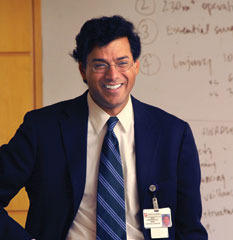
Atul Gawande
Atul Gawande

Atul Gawande is a renowned American surgeon and writer. Born on November 5, 1965, in Mumbai, India, he immigrated to the United States. Gawande is known for his expertise in surgery and his profound insights into the healthcare system. His writings cover a range of topics from surgical techniques to medical ethics, and have been well-received by readers. more

You May Also Like

“It isn’t always a matter, we should note, of identifying with the protagonist. No one I know, regardless of how much they love his novel, wants to be Humbert Humbert or Victor Frankenstein, although perhaps for different reasons. Or Heathcliff. Ever want to be Heathcliff? I didn’t think so. They are not the stuff of our fantasy lives, yet we may revel in their world, even while reviling their personalities. Consider Humbert. The narrative strategy Nabokov employs is very daring, since it demands that we identify with someone who is breaking what nearly everyone will consider the most absolute taboo. …Sympathy is out of the question. What the novel requires, however, is that we continue reading, something it audaciously gives us reason to do. The word games and intellectual brilliance helps, certainly; he’s detestable but charming and brilliant. The other element is that we watch him with a sort of appalled fascination: can he really intend that; does he really do this; would he really attempt even that; has he lost all sense of proportion? The answers are, in order, yes, yes, yes, and yes. Pretty clearly, then, there are pleasures in the text that are not inherent in the personality of the main character.”

“By honing your presence in each of your social encounters, you may be able to convey to them that their inputs and necessities matter. This may prompt them to open up further and confide more things to you, and you may even receive more favors that can end up improving your own condition.”

“Films and television let us experience other lives vicariously, or perhaps voyeuristically, as we watch those lives play out. But in a novel, we can become those characters, we can identify from the inside with someone whose life is radically different from our own. Best of all, when it’s over … we get to be ourselves again, changed slightly or profoundly by the experience, possessed of new insights perhaps, but recognizably us once more.”

“Bluntly and quietly, in a series of simple, forthright sentences, she dismantled the architecture of unhappiness that had been growing up around us for the past several days. She was calling from the office she said, and had to talk in a low voice, 'but if you can hear me, Sid' she began, 'there are four things I want you to know. First, I haven't stopped thinking about you since I left the house this morning. Second, I've decided to have the baby, and we're never going to use the word "abortion" again. Third, don't bother to make dinner. [...] Fourth, make sure Mr. Johnson's ready for action. I'm going to attack you the minute I walk in the door, my love, so be prepared.”

“As Anna poured her heart out over the phone, Ted's own heart lit up like a solar flare. He wanted nothing more than to show Anna how he saw her: how beautiful and perfect she was in his eyes. He needed to let her know that he was going to carry that memory—that knowledge—of her inside him, so that no matter what happened between them, no matter how down she got on herself, he could do this for her: he could love her, selflessly and unceasingly, with total commitment and purity, for the rest of his life. An hour later, Anna sniffled. 'Thank you for listening, Ted,' she said. 'It really means a lot to me.' I would die for you, Ted thought. 'No problemo,' Ted said.”