Quotessence
Home / Quotes / Quote by Swami Vivekananda

Quote by Swami Vivekananda

“Curiously enough, it seems that at times the spiritual side prevails, and then the materialistic side—in wave-like motions following each other. ...At one time the full flood of materialistic ideas prevails, and everything in this life—prosperity, the education which procures more pleasures, more food—will become glorious at first and then that will degrade and degenerate. Along with the prosperity will rise to white heat all the inborn jealousies and hatreds of the human race. Competition and merciless cruelty will be the watchword of the day. To quote a very commonplace and not very elegant English proverb, "Everyone for himself, and the devil take the hindmost", becomes the motto of the day. Then people think that the whole scheme of life is a failure. And the world would be destroyed had not spirituality come to the rescue and lent a helping hand to the sinking world. Then the world gets new hope and finds a new basis for a new building, and another wave of spirituality comes, which in time again declines. As a rule, spirituality brings a class of men who lay exclusive claim to the special powers of the world. The immediate effect of this is a reaction towards materialism, which opens the door to scores of exclusive claims, until the time comes when not only all the spiritual powers of the race, but all its material powers and privileges are centered in the hands of a very few; and these few, standing on the necks of the masses of the people, want to rule them. Then society has to help itself, and materialism comes to the rescue.”

Quote by Swami Vivekananda

Work

The Complete Works of Swami Vivekananda, Volume 3

Browse quotes and source details for this work. more

Author
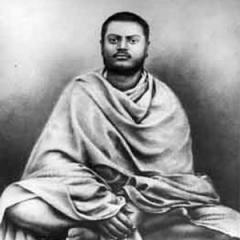
Swami Vivekananda
Swami Vivekananda

Swami Vivekananda (January 12, 1863 – July 4, 1902) was an Indian Hindu monk, philosopher, and social reformer. Born as Narendranath Datta in Kolkata, he was a chief disciple of the mystic Ramakrishna. He is best known for his historic speech at the 1893 Parliament of the World's Religions in Chicago, where he introduced Hinduism to the Western world. He founded the Ramakrishna Mission in 1897, focusing on social service, education, and interfaith harmony. His teachings emphasized self-realization, service to humanity, and the unity of all religions. He wrote extensively on yoga and Vedanta philosophy, influencing global spirituality and Indian nationalism. He died at the age of 39, leaving a lasting legacy as a bridge between Eastern and Western thought. more

You May Also Like

“He turned from the sight of human ignorance and human fate and the sea eating the ground we stand on, which, had he been able to contemplate it fixedly might have led to something; and found consolation in trifles so slight compared with the august theme just now before him that he was disposed to slur that comfort over, to deprecate it, as if to be caught happy in a world of misery was for an honest man the most despicable of crimes.”

“… an Emperor says, "I will kill you if you do not come", and the man bursts into a laugh and says, "You never told such a falsehood in your life, as you tell just now. Who can kill me? Me you kill, Emperor of the material world! Never! For I am Spirit unborn and undecaying; never was I born and never do I die; I am the Infinite, the Omnipresent, the Omniscient; and you kill me, child that you are!" That is strength, that is strength!”

“Passing to historical nations, we must first point out that in relation to them the word race cannot and should not be used at all. We do not know of any historical nation that can be regarded as racially pure; each of them is the product of an extremely lengthy and intense process of interbreeding and intermingling of different ethnic elements. Now try, after this, to determine the influence of “race” on the history of the ideologies of any nation! At a first glance it seems that nothing could be simpler and more correct than the idea that natural environment influences national temperament and, through temperament, the history of the nation’s intellectual and aesthetic development. But if Labriola had only recalled the history of his own country, he would have been convinced of the erroneousness of this idea. The modern Italians are surrounded by the same natural environment as that in which the ancient Romans lived, yet how unlike is the “temperament” of our modern tributaries of Menelik to the temperament of the stern conquerors of Carthage! If we were to undertake to explain the history of Italian art, for example, by the Italian temperament, we should very soon be confronted by the baffling question why this temperament, for its part, varied so profoundly at different times and in different parts of the Apennine Peninsula.”

“Often people that say they “don’t care” actually do. The moment they discuss you with their friends and family, compete with you, bad mouth you to others or react to anything you do or say is when they give themselves away. You can either be saddened or flattered that you effected someone so much. The perspective is yours to determine.”