Quotessence
Home / Quotes / Quote by Friedrich Nietzsche

Quote by Friedrich Nietzsche

“It happens more frequently, as has been hinted, that a scientific head is placed on an ape’s body, a fine exceptional understanding in a base soul, an occurrence by no means rare, especially among doctors and moral physiologists. And whenever anyone speaks without bitterness, or rather quite innocently, of man as a belly with two requirements, and a head with one; whenever any one sees, seeks, and WANTS to see only hunger, sexual instinct, and vanity as the real and only motives of human actions; in short, when any one speaks ‘badly’—and not even ‘ill’—of man, then ought the lover of knowledge to hearken attentively and diligently; he ought, in general, to have an open ear wherever there is talk without indignation. For the indignant man, and he who perpetually tears and lacerates himself with his own teeth (or, in place of himself, the world, God, or society), may indeed, morally speaking, stand higher than the laughing and self- satisfied satyr, but in every other sense he is the more ordinary, more indifferent, and less instructive case. And no one is such a LIAR as the indignant man.”

Quote by Friedrich Nietzsche

Author
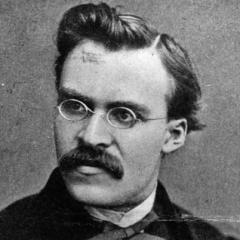
Friedrich Nietzsche
Friedrich Nietzsche

Friedrich Nietzsche was a German philosopher, cultural critic, poet, and writer whose works have had a profound impact on subsequent philosophy, literature, and thought. His ideas revolve around concepts such as the 'will to power', the 'Übermensch', and the 'eternal recurrence'. more

You May Also Like

“If your curiosity reaches a breaking point (compelled actually means that you only have the remaining choice to act on it, having tried all the other options before), and becomes fascination with mystery or truth, you find what you need. Maybe it’s a person, maybe it’s a tragedy, maybe it’s an explosive recognition that, “My God, I’m still alive.”

“It takes a relative amount of courage just to get out of bed each day. There are those who are stronger in their courage, and they help to compel us along a little further in the fulfillment of our faith.”

“My take on personal evolution is largely about the spirit of connecting and disconnecting things, relating to what I call “the gap” or time and space between things. It is also about becoming practical in all this, developing the power and precision to simply bring the grand ideas home, to compress the paradigm of perception/choice/action/result into a single gesture.”

“What you have to do to achieve what you want necessitates the creative actualization of the totality of your being as it is. Nothing more, but also nothing less.”

“Even then, I was dreaming of Raistlin's black robes one moment, and Dorsett's spin move the next. This was what my father deeded--that our Knowledge of Self be more than America, that we understand the brain death that sprawled from the projects to the subdivisions. Consciousness was a beginning, but the imagination could turn straight 18s into paladins in plate, could make warrens in tunnels from graph paper, could pull armies of gnolls from miniatures--that was the Knowledge that ultimately would find a way out.”

“The seed of all this is imagination. But when you think of imagination, it helps to view it more as it exists in the rest of nature, rather than as we tend to see it in humans. That is, that imagination is actual and a need, immediately searches for expression, and con- sequently, is intimately connected to yearning and its instantaneous application. This is also the case in human beings, but we generally associate it with unnecessary, or extra, expression, such as an ability to make something more attractive or stimulating (the current view of art, for example), or the creative use of “free time” (time left over after you have done what you had to do).”