Quotessence
Home / Quotes / Quote by George Will

Quote by George Will

“Forever seeking Archimedean levers for prying the world in directions they prefer, progressives say they embrace high-speed rail for many reasons—to improve the climate, increase competitiveness, enhance national security, reduce congestion, and rationalize land use. The length of the list of reasons, and the flimsiness of each, points to this conclusion: the real reason for progressives’ passion for trains is their goal of diminishing Americans’ individualism in order to make them more amenable to collectivism.”

Quote by George Will

Author
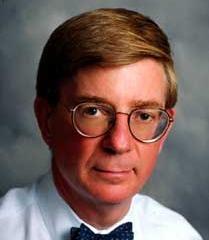
George Will
George Will

George Will (born May 4, 1941) is a prominent American conservative political commentator, columnist, and author. He is best known for his syndicated column in The Washington Post, which earned him a Pulitzer Prize for Commentary in 1977. Will is also a regular contributor to Fox News and has written numerous books on politics, culture, and baseball. His work emphasizes traditional values, limited government, and free markets, making him a key figure in modern American conservatism. more

You May Also Like

“The man who did the shooting was a civilian, Peter Kakhovsky, a gifted intellectual of extreme purity of motive in whom the conviction of the necessity of regicide burned with a gem-like flame. Determined to kill, expecting to die, this brilliant and terrible apparition, his slender form bundled up in a sheepskin coat, his delicate features surmounted by a shabby top hat, shot to kill with that indiscriminate ruthlessness which was later to characterise a whole generation of revolutionary terrorists. If he could not yet murder the Tsar, he would do the next best thing.”

“One common criticism emerged from Congress and the media: Obama had not formally addressed the nation since authorizing military action. So, on March 28, two weeks after the Situation Room meeting that had set everything in motion, he gave a speech at the National Defense University in Washington. The television networks said they wouldn’t carry it in prime time, so it was scheduled for the second-tier window of 7:30 P.M., an apt metaphor for the Libyan operation—cable, not network; evening, not prime time; kinetic military operation, not war. The speech was on a Monday, and I spent a weekend writing it. Obama was defensive. Everything had gone as planned, and yet the public and political response kept shifting—from demanding action to second-guessing it, from saying he was dithering to saying he wasn’t doing enough. Even while he outlined the reasons for action in Libya, he stepped back to discuss the question that would continue to define his foreign policy: the choice of when to use military force. Unlike other wartime addresses, he went out of his way to stress the limits of what we were trying to achieve in Libya “—saving lives and giving Libyans a chance to determine their future, not installing a new regime or building a democracy. He said that we would use force “swiftly, decisively, and unilaterally” to defend the United States, but he emphasized that when confronted with other international crises, we should proceed with caution and not act alone.”

“One after another, they offered an unvarnished view of the chaos engulfing the region, and Syria in particular. The trends were not good—opposition movements were becoming more extremist, Iran was doubling down on its support for Assad in Syria, Gulf countries were funding groups in Syria and Libya that were more militant than the United States wanted. Most of them argued that the United States was failing to shape events, though I noticed that the most senior correspondent lacked any hope that events could be shaped. Obama listened intently, asking questions as much as he offered his own opinions. When the session was over, I followed him into the Oval Office, where I quickly realized that the session had had the opposite of the effect I intended—where I heard a call to action, Obama had heard a cautionary tale. How could the United States fix a part of the world that was that broken, and that decades of U.S. foreign policy had helped to break?”

“We were in the middle of a three car caravan accompanied by Jim Carlisle, a career diplomat and the perfect Charge’ de Affaires. His manner was formal but always with a practiced smile to make his counterparts feel at ease. He sat in the jump seat in front of Owen, Alex and I sat together in the back near the double cargo doors guarding the luggage. The driver was Pakistani as was the security guard on the passenger side. The cars were crossing a bridge when it happened. First the blinding flash, then the delayed sound, it was deafening with the unmistakable smell of high explosives. The Ford Expedition in front erupted in a mushroom cloud of smoke and fire as it leaped off the road and settled back in a black pile of melting plastic, glass and metal. Our driver slammed on the brakes, ramming the gear into reverse while twisting his body around for a better view out the rear door windows. It was to late, the car behind us had met the same fate, we were bookended by smoking heaps of scrap metal as the masked bombers, five of them, surrounded our SUV. This was a professional hit team, their leader was calm, he directed the others with chilling efficiency. They wore black ski masks, bullet proof vests and ear phone sets, only the leader spoke, the others took orders. The shortest one had a knapsack, he turned his back to another who unzipped it and removed the gray matter, it looked like putty, he slapped it hard against the double rear doors. These would be the most vulnerable, they locked together rather than to the structural integrity of the vehicle. Both doors exploded out and away from the car dangling precariously on their hinges. The short one jumped in first, throwing the luggage out and scrambling towards us as our security guard leveled his government issue Glock-45, he hesitated to long, the red dot sighting device from the backup shooter was in the center of his forehead. The bone and brain fragment from the melon sized exit wound in the back of his head splattered against the windshield. The driver went for the concealed weapon under the front seat but thought better of it as the bombers surrounded the vehicle. Outside the driver side window, the leader hit the bullet proof glass with the butt of his matt black automatic, he wanted the doors opened, the driver had already hit the lock release.”

“Current public diplomacy and foreign policy making reduces the role of American citizens to mere spectators. The USIA's model of democracy and the free market is promoted as the superpower version of economic globalization, packaged and ready for shipping to clients throughout the world. In this version, foreign capital flows freely while the movement of people, particularly the world's poor, is strictly controlled. Such a commercial package speaks first and foremost for government 'partners,' the Fortune 500 corporations, which are the primary beneficiaries as well as the bankrollers of the American political process. This is a packaged story of America that is incomplete and undemocratic. Where do workers and communities fit into the story? How do private citizens play a part in building dialogue across cultures?”

“[Robert] Pastor explains that the United States did not want to control Nicaragua or other nations in the region, but it also didn't want to allow developments to get out of control. It wanted Nicaraguans to act independently, except when doing so would affect US interests adversely. In short, Nicaragua and other countries should be free: free to do what we want them to do, and should choose their course independently, as long as their choice conforms to our interests. If they use the freedom we accord them unwisely, we are entitled to respond with violence, in self-defence.”