Quotessence
Home / Quotes / Quote by Thomas Jefferson

Quote by Thomas Jefferson

“I have observed, indeed, generally, that while in protestant countries the defections from the Platonic Christianity of the priests is to Deism, in catholic countries they are to Atheism. Diderot, D'Alembert, D’Holbach, Condorcet, are known to have been among the most virtuous of men. Their virtue, then, must have had some other foundation than the love of God. [Letter to Thomas Law, 13 June 1814]”

Quote by Thomas Jefferson

Work

Letters of Thomas Jefferson

Browse quotes and source details for this work. more

Author
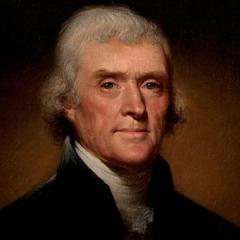
Thomas Jefferson
Thomas Jefferson

Thomas Jefferson was the third President of the United States, a distinguished politician, philosopher, architect, and scientist. He was born on April 13, 1743, and died on July 4, 1826. Jefferson advocated for democracy and freedom in politics and was one of the main authors of the Declaration of Independence. His political ideas had a profound impact on the founding and development of the United States. more

You May Also Like

“With the growth of civilisation in Europe, and with the revival of letters and of science in the fourteenth and fifteenth centuries, the ethical and intellectual criticism of theology once more recommenced, and arrived at a temporary resting-place in the confessions of the various reformed Protestant sects in the sixteenth century; almost all of which, as soon as they were strong enough, began to persecute those who carried criticism beyond their own limit. But the movement was not arrested by these ecclesiastical barriers, as their constructors fondly imagined it would be; it was continued, tacitly or openly, by Galileo, by Hobbes, by Descartes, and especially by Spinoza, in the seventeenth century; by the English Freethinkers, by Rousseau, by the French Encyclopaedists, and by the German Rationalists, among whom Lessing stands out a head and shoulders taller than the rest, throughout the eighteenth century; by the historians, the philologers, the Biblical critics, the geologists, and the biologists in the nineteenth century, until it is obvious to all who can see that the moral sense and the really scientific method of seeking for truth are once more predominating over false science. Once more ethics and theology are parting company.”

“Shit. I don’t want to hear one more person tell me how great I used to be, and how horrible I am now. I know they think that’s a compliment, I know they think they’re telling me something about my native character that I ought to be happy about, but it just breaks my heart. What’s wrong with me? Even when I was the person I used to be, I was not very happy. If anything, I am happier now, and everyone else is displeased. I can’t win.”

“And I have to act as if. That’s a big recovery term: act as if. Act as if you believe you will stay sober. Act as if you like meetings. Act as if you believe in God. Act as if you like getting on your knees and praying each morning and night. Act as if there is a lot of wisdom in the Big Book and the Twelve Steps. Act as if there is a point to making your bed each day, even if you are just going to get back into it that night. Act as if everyone around you is not an idiot, and treat others with respect. They like to say: “You can’t think your way into acting, but you can act your way into thinking.” The idea is that if you do what you are supposed to, your mind might catch up with your body. If I stop acting as if therapy is one big useless joke that I have been in for twenty years only to land in a mental institution at long last, if I act as if this time it’s for real and this time it will work, it just might. It just might. And I have to count on those mights, all of them. They’re all I’ve got right now.”