Quotessence
Home / Quotes / Quote by Melinda Gates

Quote by Melinda Gates

Work

The Moment of Lift: How Empowering Women Changes the World

Browse quotes and source details for this work. more

Author
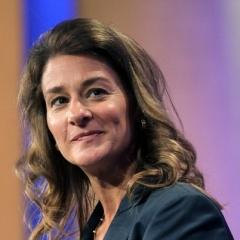
Melinda Gates
Melinda Gates

Melinda Gates is a distinguished businesswoman and philanthropist, co-founder of the Bill & Melinda Gates Foundation, one of the world's largest private foundations. She has been deeply involved in the foundation's efforts to improve global health and education, with a particular focus on reducing poverty and enhancing lives worldwide. more

You May Also Like

“So this is Paris, where my great-grandparents came from...the place that gave me my roots...and new friends! My house has a thousand rooms...one for every place we've passed through! My ceiling is sometimes a dome of stars...other times a fiery sunset...and still other times...the wild dance of storm clouds... My time is that of the seasons... My family speaks all languages... But we don't have to open our mouths to understand each other. One look is enough... We work together to create something that none of us alone would be able to. We mix our diversities with passion and what comes out is infinitely better than what is mine or yours... Grandad Tenzin would say it's alchemy. While it's true that I don't have a tiled roof, brick walls or a fixed address to write on an envelope...if you think about it I have much, much more... Swimming pool with a view... Gymnastics and acrobatic lessons every day... Ethnic cuisines and nightly entertainment... And day after day I can enjoy everything...without possessing anything! I read somewhere --WHERE YOUR TREASURE LIES, THERE YOUR HEART WILL BE. Well my heart lies with this big family of travelers... They are my treasure! That's why I can feel at home anywhere, though I have no home anywhere... Deep down, wanderers are like flowing rivers.. which, with their twists and turns, are always looking for their own way to reach the sea... If you think about it, isn't the same true of everyone? We may go along our separate ways , but our hearts must beat the world over!”

“Why [...] is it so hard to build a society in which race does not matter? To the extent that Americans even ask themselves this question, they would say that it is because Americans--whites, especially--have not tried hard enough. And yet, how much harder can a people try? Today, after 50 years of trying, most whites cannot muster much more than exhausted resignation in the face of reports on school resegregation and yawning gaps in test scores or poverty rates. [...] If, generation after generation, Americans tend to segregate themselves, is it possible that the expectations for integration were not reasonable? If diversity is a source of tension are there risks in basing policies on the assumption that it is a strength? If non-white groups continue to advance race-based interests, is it wise for whites to continue to act as if they have none?”

“As the nation diversifies, the homogeneous communities that people seem to prefer become increasingly fine grained. When immigrants become landlords, many rent only to people from their own country. Apartment buildings can become entirely Korean, Salvadoran, or Guatemalan, for example. Immigrant landlords are often unaware of non-discrimination laws, and do not hesitate to tell others they are not welcome. A lawyer for Neighborhood Legal Services of Los Angeles noted that some managers rent only to people from a particular state of Mexico, adding, 'Our fair housing laws haven't even anticipated that.”

“Universities promote diversity. On April 24, 1997, 62 research universities led by Harvard bought a full-page advertisement in the New York Times that justified racial preferences in university admissions by explaining that diversity is a “value that is central to the very concept of education in our institutions.” Lee Bollinger, who has been president of the University of Michigan and of Columbia, once claimed that diversity “is as essential as the study of the Middle Ages, of international politics and of Shakespeare.” Many companies and universities have a “chief diversity officer” who reports directly to the president. In 2006, Michael J. Tate was vice president for equity and diversity of Washington State University. He had an annual budget of three million dollars, a full time staff of 55, and took part in the highest levels of university decision-making. There were similarly powerful “chief diversity officers” at Harvard, Berkeley, the University of Virginia, Brown, and the University of Michigan. In 2006, the University of Wisconsin at La Crosse decided that diversity was so important that its beneficiaries—students—should pay for it. It increased in-state tuition by 24 percent, from $5,555 to $6,875, to cover the costs of recruitment to increase diversity.”

“American law schools are accredited by the American Bar Association (ABA), which uses its power to promote diversity. In 2000, the ABA discovered that 93.5 percent of first-year students at George Mason University law school in northern Virginia were white. The ABA recognized that GMU had made a “very active effort to recruit minorities,” but said it had not done enough. With its accreditation at stake, GMU law school lowered standards for non-white applicants and admitted more: 10.98 percent in 2001 and 16.16 percent in 2002. That was still not enough. In 2003, the ABA summoned GMU’s president and law school dean and threatened them to their faces with disaccreditation unless they admitted more non-whites. GMU lowered standards even further, and managed to raise its non-white admissions to 17.3 percent in 2003, and 19 percent in 2004. This was still not good enough. “Of the 99 minority students in 2003,” the ABA complained, “only 23 were African American; of 111 minority students in 2004, the number of African Americans held at 23.” True diversity required more blacks, but what of the blacks GMU did admit? From 2003 to 2005, fully 45 percent had grade-point averages below 2.15, which was defined as “academic failure.” For non-black students, the figure was 4 percent. GMU officials pointed out that the ABA’s own Standard 501(b) says that “a law school shall not admit applicants who do not appear capable of satisfactorily completing its educational program and being admitted to the bar.” Law school dean Dan Polsby explained that this requirement was the greatest obstacle to increased diversity.”

“Blacks do not see the arrival of Hispanics as an opportunity to celebrate diversity. By 1999, there were 26 schools in the Los Angeles Unified School District in which Hispanics were a majority of the students but blacks were a majority of the staff. Hispanic parents demanded more Hispanic staff but blacks would not step down. As Celes King III, president of the Congress for Racial Equality, who once led a demonstration against a white principal at Manual Arts High School, noted, with no apparent sense of irony: 'The situation has gone full circle. The Hispanics are using the same thoughts and practices we used 30 years ago. . . . We need to organize and maintain our positions in education because we worked so hard for them.”