“An electronic machine can carry out mathematical calculations, remember historical facts, play chess and translate books from one language to another. It is able to solve mathematical problems more quickly than man and its memory is faultless. Is there any limit to progress, to its ability to create machines in the image and likeness of man? It seems the answer is no. It is not impossible to imagine the machine of future ages and millennia. It will be able to listen to music and appreciate art; it will even be able to compose melodies, paint pictures and write poems. Is there a limit to its perfection? Can it be compared to man? Will it surpass him? Childhood memories… tears of happiness … the bitterness of parting… love of freedom … feelings of pity for a sick puppy … nervousness … a mother’s tenderness … thoughts of death … sadness … friendship … love of the weak … sudden hope … a fortunate guess … melancholy … unreasoning joy … sudden embarrassment… The machine will be able to recreate all of this! But the surface of the whole earth will be too small to accommodate this machine – this machine whose dimensions and weight will continually increase as it attempts to reproduce the peculiarities of mind and soul of an average, inconspicuous human being. Fascism annihilated tens of millions of people.”
Quote by Vasily Grossman
Work
Browse quotes and source details for this work. more
Author
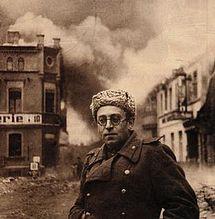
Vasily Grossman (December 12, 1905 – September 14, 1964) was a Soviet Jewish writer and journalist, best known for his works on World War II. Born in Berdychiv, Ukraine, he initially studied chemical engineering before turning to literature. As a war correspondent for the Red Star newspaper, he witnessed the Battle of Stalingrad and documented Nazi atrocities. His masterpiece, Life and Fate, was banned by Soviet authorities for its criticism of Stalinism and only published in the 1980s. Grossman's works explore themes of war, totalitarianism, and humanity, earning him recognition as a significant voice in 20th-century Russian literature. more
You May Also Like
“Conformity is usually beneficial to society, but is often detrimental to individuality.”
“In many instances it is not insanity, but individuality that caused women to be committed.”
“Individuality, Poetry and Sarcasm are the three most precious human possessions.”